Read the Ground Before You Read the Map: How to Find Primitive Tool Materials Written in Your Local Geology
Before the first hardware store opened, before the first forge was lit, human beings were reading the ground beneath their feet and finding everything they needed to build tools, process food, and stay alive. The knowledge wasn't mystical—it was systematic. They understood their local geology the way a modern mechanic understands an engine.
That knowledge didn't vanish. It's still written in the rock formations of every region in the United States. You just need to know how to read it.
This is a practical guide to doing exactly that.
Why Geology Is a Survival Skill
Most preppers think about resources in terms of what they've stored. But stored resources are finite—and in a prolonged crisis, finite resources run out. The land around you is a renewable, inexhaustible supply of raw materials for primitive tools if you understand what you're looking at.
Knowing your regional geology tells you where to find:
- Flint, chert, and obsidian for cutting edges
- Dense igneous or metamorphic stone for axe heads and hammers
- Flat sedimentary stone for grinding and abrading
- Natural spring locations and water-bearing rock formations
- Clay deposits for pottery and heat-resistant construction
None of this requires a geology degree. It requires curiosity, observation, and a basic framework for understanding what different rock types look like and where they occur.
The Three Rock Types and What They're Good For
Every rock on earth falls into one of three categories. Understanding them is the foundation of everything else.
Igneous rock formed from cooled magma. It tends to be dense, hard, and durable. Basalt, granite, and obsidian are all igneous. Obsidian—volcanic glass—is the gold standard for knapping a cutting edge. It fractures in a perfectly predictable conchoidal pattern and can be worked to an edge sharper than surgical steel. Basalt makes excellent hammer stones and axe blanks. Granite works well for grinding surfaces.
Sedimentary rock formed from compressed layers of material over time. Flint and chert are sedimentary silica rocks—the workhorses of primitive toolmaking across North America. They fracture in the same conchoidal pattern as obsidian, though they require more skill to work cleanly. Limestone and sandstone are also sedimentary; sandstone is particularly useful as an abrasive for shaping and sharpening other tools.
Metamorphic rock formed when existing rock was transformed by heat and pressure. Quartzite is a metamorphic rock that makes excellent hammer stones and can be knapped in a pinch. Slate splits into flat, workable layers and has been used for scraping tools and arrow points.
Regional Geology by US Zone: What to Look For Where
The Pacific Northwest and California: This is obsidian country. The Cascade Range and Sierra Nevada are littered with volcanic deposits, and obsidian sources are abundant from northern California through Oregon and into Washington. The Glass Buttes area of Oregon is legendary among flintknappers. Basalt is everywhere. If you're in this region, you're sitting on some of the best primitive toolmaking material in North America.
The Great Plains and Midwest: Flint and chert are your primary materials here. Flint Hills in Kansas is exactly what it sounds like—one of the most significant flint deposits on the continent. Kansas flint (also called Permian chert) is dense, fine-grained, and excellent for knapping. The Ohio Valley has significant flint deposits as well, including the famous Flint Ridge in Ohio, which was a major toolstone quarry for prehistoric peoples across a wide region.
The Southeast: Chert and quartzite are common throughout the Appalachians. Georgia, Alabama, and Tennessee all have significant chert deposits. The Tennessee River valley in particular has yielded high-quality toolstone for thousands of years. Coastal areas offer shell for scrapers and cutting tools—don't overlook marine materials.
The Northeast: New England is largely metamorphic and igneous terrain. Quartzite, rhyolite, and argillite were the primary toolstones for Northeastern Native peoples. Rhyolite—a fine-grained volcanic rock—knaps reasonably well and is common in the Mid-Atlantic region. Pennsylvania and New York have chert deposits worth scouting.
The Desert Southwest: This region is exceptional for primitive toolmakers. Arizona, New Mexico, Nevada, and Utah have obsidian, chert, jasper, and petrified wood—all of which knap well. Petrified wood is essentially silicified wood, and it fractures in the same conchoidal pattern as flint. If you find it, use it.
How to Scout Your Area Like a Prehistoric Toolmaker
Here's a practical framework for reading your local terrain:
Start with a USGS geological map. The US Geological Survey has free digital maps of every region in the country at usgs.gov. Look for formations labeled as chert, flint, obsidian, basalt, or quartzite in your area. These maps tell you where to start looking—they don't tell you exactly where to dig, but they point you in the right direction.
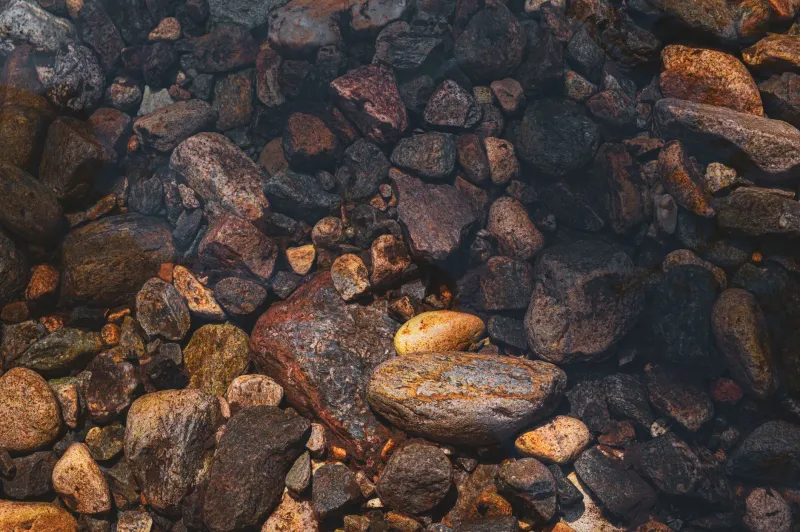
Follow the water. Streams and rivers are your best field scouts. Moving water erodes rock formations and deposits toolstone in gravel bars and creek beds. Walk any creek in your area and pick up every smooth, glassy-looking stone. Test potential toolstone by striking it with a hammerstone—good flint and chert will produce a sharp, ringing sound and fracture cleanly. Dull, crumbling material is useless for knapping.
Look for color and luster. Quality knapping stone tends to have a waxy or glassy sheen. Flint and chert often come in gray, tan, brown, or reddish tones. Obsidian is black and glassy. Avoid porous, grainy-looking stone—it won't hold an edge.
Check road cuts and construction sites. Anywhere the earth has been cut open is a free geology lesson. Road cuts through hillsides expose rock strata that you'd otherwise never see. Pay attention to what's exposed and match it against your geological map.
Note your spring locations. Springs emerge where permeable rock meets impermeable rock and water is forced to the surface. Understanding this means you can predict spring locations from a geological map—a critical skill in arid regions where surface water is scarce.
A Quick Field Test for Toolstone Quality
When you find a candidate rock, run it through this quick assessment:
- Hardness test: Scratch it with a steel knife blade. Good toolstone (quartz-family minerals) will scratch the steel, not the other way around.
- Strike test: Hit it with another hard rock. Does it fracture cleanly with a sharp edge, or does it crumble? Clean fracture means workable material.
- Sound test: A good piece of flint or chert rings clearly when struck. Dull thudding indicates internal fractures or poor grain structure.
- Visual inspection: Look for inclusions, cracks, or fossils running through the stone. These are stress points that will cause the stone to fail unpredictably when you're trying to shape it.
The Bigger Picture
Knowing your regional geology isn't just about finding rocks to make tools. It's about understanding your terrain at a fundamental level—the same level the people who survived here for thousands of years understood it. They didn't need a supply chain because the land was their supply chain.
You live somewhere. That somewhere has specific geology, specific rock types, specific water patterns. Learning to read those patterns is one of the highest-value survival skills you can develop, because it works everywhere, costs nothing, and never runs out of batteries.
Get outside. Pick up some rocks. The ground has been waiting to tell you something.