Your Body Isn't Ready: The Real Physical Demands of Working with Primitive Hand Tools
Most people who decide to get serious about primitive skills—chopping wood, hand-sawing timber, working leather, splitting shakes—discover the same hard truth within the first few days: they are not physically prepared for this. Not even close.
It's humbling. You might be a guy who hits the gym three times a week, runs on weekends, and considers himself reasonably fit. And then you spend four hours with a hand saw and a drawknife and wake up the next morning unable to fully extend your fingers. The gym didn't prepare you for this. Nothing modern does.
Understanding why—and doing something about it—is the difference between being genuinely capable in a primitive or grid-down situation and being a liability after day two.
Why Hand Tools Hit Differently
Powered tools do most of the work. A circular saw converts motor energy into cutting force. A drill press applies torque mechanically. Your job is to guide, aim, and control—not to generate force. The physical demand is real, but it's intermittent and largely stabilizing.
Hand tools are the opposite. Every bit of cutting, splitting, shaping, or driving force comes directly from your body. You are the motor. And unlike a motor, your body has specific weak points that hand-tool work targets with almost surgical precision.
The demands are also sustained in a way that most gym work isn't. A set of deadlifts takes thirty seconds. Bucking a downed tree by hand can take two hours of continuous effort. The metabolic and muscular demands are fundamentally different—more similar to a trail crew or a harvest crew than anything you'd find in a modern fitness program.
The Muscle Groups Nobody Talks About
Forearm flexors and extensors. Every grip, every pull, every push with a hand tool runs through your forearms. Sawing is essentially a high-repetition forearm exercise performed under load for extended periods. Most gym programs neglect direct forearm work almost entirely. The result is that even strong people with big biceps and powerful lats hit a forearm wall early.
The intrinsic hand muscles. These tiny muscles between the metacarpals—the ones that control fine grip and finger spacing—get absolutely lit up by tool work. Gripping an axe handle, adjusting grip on a drawknife, working leather with an awl—all of it stresses muscles that most people have never consciously trained.
The posterior shoulder and rotator cuff. Overhead axe work, adzing, and even sustained hand-sawing place enormous rotational demand on the shoulder. The rotator cuff—specifically the infraspinatus and teres minor—stabilizes every one of those movements. Gym pressing and rowing don't adequately develop these stabilizers for the specific patterns of tool work.
The thoracic extensors. Leaning over a workbench, bending into a draw stroke, stooping to work low on a log—hand-tool work is full of sustained flexion positions. The upper and mid-back extensors that hold you upright under that load are chronically undertrained in most fitness programs.
The hip hinge chain. Splitting wood, driving stakes, and heavy mallet work all involve a hip-hinge power transfer. If your glutes and hamstrings aren't tuned for this specific pattern, your lower back picks up the slack—and pays for it.
The Joint Stress Problem
Beyond muscles, hand-tool work creates joint stress patterns that deserve specific attention.
The wrists take the most abuse. The repetitive shock of a hammer or axe transmits through the tool handle into the wrist joints. Over time, this creates inflammation in the tendons that cross the wrist—a condition old-time craftspeople called "tooler's wrist" and that modern medicine calls lateral epicondylitis or de Quervain's tenosynovitis, depending on which tendons are involved.
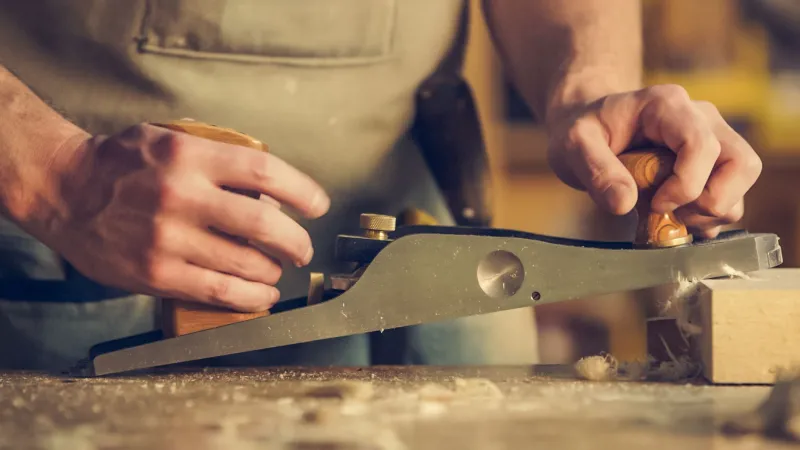
The elbow is similarly vulnerable. Repetitive gripping and forearm pronation—the motion of turning a brace and bit or working a hand plane—loads the medial and lateral epicondyles. Tennis elbow is essentially a carpentry injury that golfers and tennis players accidentally discovered.
Historical craftspeople weren't immune to these problems. Blacksmiths, coopers, and timber framers all dealt with chronic joint issues. But they also developed specific management strategies that modern people have largely forgotten.
What Historical Craftspeople Actually Did
The old-timers had a few advantages we've lost. First, they built into the work gradually. An apprentice didn't start with eight-hour days on the heaviest work. He started light and added load over months and years. His body adapted progressively.
Second, they used task rotation instinctively. A blacksmith didn't hammer for eight straight hours. He alternated between heavy forging, lighter shaping, file work, and fitting. Different tasks loaded different structures and gave stressed tissues partial recovery.
Third, they used heat and cold therapeutically. Soaking hands in warm water with Epsom salts at the end of a long day was common practice. Cold water immersion after particularly heavy work reduced acute inflammation. These aren't folk remedies—they're effective recovery tools that physical therapists still recommend.
Conditioning for the Work
If you want to build real hand-tool capacity, here's where to start:
Grip work, done properly. Not just squeezing a gripper. Use thick-handled implements. Farmer carries with handles wrapped in rope or towel. Dead hangs from a bar. Towel pull-ups. The goal is time under tension with varied grip positions, not just maximum closing force.
Wrist conditioning. Wrist curls and reverse wrist curls with light weight and high reps. Radial and ulnar deviation work. Wrist circles under load. These are unglamorous exercises that make a significant difference.
Rotator cuff work. External rotation with a band or light dumbbell. Face pulls. These don't need to be heavy—they need to be consistent.
Sustained low-intensity work. The best preparation for hand-tool endurance is hand-tool work itself, done progressively. Start with thirty-minute sessions. Add time weekly. Let your connective tissue adapt—it adapts slower than muscle, and trying to rush it is how you get injured.
Recovery protocols. Contrast bathing—alternating warm and cold water on your forearms and hands—accelerates recovery between sessions. Keep your forearms and hands warm during work in cold weather; cold tissue is injury-prone tissue.
The Adaptation Curve Is Real
Here's the honest truth: the first two weeks of real hand-tool work will humble almost anyone. Your hands will be sore. Your forearms will be tight. Your shoulder will ache in unfamiliar places.
This is normal. It's adaptation, not injury—as long as you're progressing sensibly and not ignoring sharp or persistent pain.
By week four or five, something shifts. Calluses form. Grip endurance climbs. The shoulder stabilizers wake up. You start to feel the rhythm of the work rather than the fight of it. Historical craftspeople called this "finding your stroke," and it's a real physiological phenomenon—your nervous system learning to recruit the right muscles in the right sequence with the right timing.
Once you're there, you'll understand why the men who built this country with hand tools could work from sunup to sundown and do it again the next day. They weren't superhuman. They were adapted.
Get adapted before you need to be. Your future self will thank you.