When the Power Cuts Out, Grandpa's Toolbox Cuts In
Walk into almost any American garage today and you'll find a wall of battery-powered tools, a tangle of extension cords, and maybe a shop vac humming in the corner. It's impressive, no doubt. But every single one of those tools has the same fatal flaw: it needs electricity to function. Pull the plug—whether through a storm, a grid failure, or something worse—and that impressive setup is just dead weight on a pegboard.
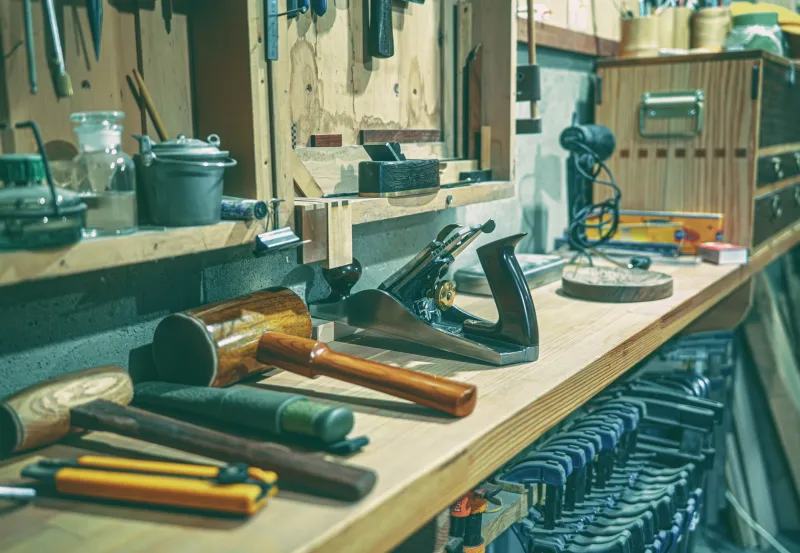
Hand tools don't have that problem. A well-set hand plane doesn't care whether the power's on. A sharp crosscut saw doesn't need a charge cycle. And a set of chisels will still be working long after every lithium-ion battery you own has given up the ghost. Your grandfather understood this, not because he was some wilderness sage, but because he grew up in an era where you couldn't always depend on infrastructure to bail you out.
That mindset is making a serious comeback among preppers, homesteaders, and anyone paying attention to how fragile the modern supply chain actually is.
The Illusion of Modern Convenience
Power tools are genuinely great—nobody's arguing otherwise. A miter saw rips through a 2x4 in two seconds flat. A cordless drill sinks screws all day without complaint. For production work in a stable environment, they're hard to beat.
But "stable environment" is doing a lot of heavy lifting in that sentence.
Consider what it actually takes to keep your power tools running: a functioning electrical grid, or a generator and fuel supply, or a bank of charged batteries, or some combination of all three. In a short-term disruption, that's manageable. In a prolonged outage—think weeks, not hours—every one of those dependencies becomes a potential failure point. Fuel runs out. Batteries die and won't recharge. Generators break down and need parts you can't source.
Hand tools sidestep all of that. The only energy source they require is the person holding them.
The Learning Curve Is Real—and Worth Every Minute
Here's where most people get tripped up: hand tools aren't harder to use than power tools, but they are different. Using a hand saw well takes technique. Getting a hand plane dialed in requires understanding grain direction and blade geometry. Cutting a clean mortise with a chisel is a learned skill, not something you stumble into on the first try.
That learning curve is actually part of the point.
When you develop real proficiency with a hand tool, you're building a skill that lives in your body—in your hands and your muscle memory—not in a piece of hardware that can break or run out of juice. A guy who knows how to sharpen and use a drawknife can shape a handle, strip bark, or rough out a chair leg without needing anything except the tool and a shaving horse. That knowledge doesn't depreciate. It doesn't need firmware updates. Nobody can take it away from you.
Preppers who've gone deep on hand tool skills often describe a shift in how they think about projects. Instead of asking "what's the fastest way to do this," they start asking "what's the most reliable way to do this." Those aren't always the same answer.
Where Hand Tools Actually Win
Efficiency comparisons between hand and power tools almost always favor power—until you change the conditions. Here are some scenarios where the manual option isn't just viable, it's genuinely superior:
Remote locations. If you're building or repairing something far from an outlet—a hunting camp, a remote homestead, a bug-out structure—hand tools travel light and don't require a logistical tail. No generator, no extension cords, no battery management.
Noise discipline. A hand saw is quiet. A circular saw announces your position to everything within a quarter mile. If situational awareness matters—and in a real grid-down scenario, it very much does—quiet tools are tactical tools.
Precision work. Power tools are fast, but they're blunt instruments when it comes to fine joinery. A sharp chisel in practiced hands can fit joints that a router would struggle to match. Old-school cabinetmakers knew this, and so do the woodworkers who've rediscovered traditional techniques.
Maintenance simplicity. A hand plane can be fully disassembled, sharpened, and reassembled with nothing more than a flat stone and a screwdriver. Try doing a field repair on a brushless motor.
The Tools Worth Knowing
Not every hand tool is worth your time and shelf space. Here's a short list of what experienced preppers and homesteaders consistently reach for:
- Rip and crosscut hand saws — The backbone of any manual woodworking setup. A well-sharpened crosscut saw handles dimensional lumber faster than most people expect.
- Block plane and jack plane — For smoothing, fitting, and shaping wood. A jack plane is especially versatile for rough stock removal.
- Brace and bit — Forget cordless drills. A good brace can bore through hardwood all day without a single battery swap, and it gives you torque control that's hard to match.
- Chisels (set of 4-6) — Mortising, paring, cleaning joints. Keep them sharp and they'll handle almost any joinery task.
- Drawknife — Underrated by most, essential to anyone who works with green wood or natural materials.
- Marking gauge and combination square — Accuracy starts with layout. These two tools are how you avoid expensive mistakes.
What the Holdouts Say
Talk to folks who've already made the shift—homesteaders in rural Appalachia, off-grid builders in the Mountain West, urban preppers who've quietly stocked a chest of vintage Stanley and Disston tools—and you hear a consistent theme. They didn't give up power tools because they had to. They added hand tool skills because they realized they couldn't afford not to.
One Ohio homesteader put it plainly: "I still use my table saw when I can. But I know that if the power's out for a month, I can still build what I need. My neighbors can't say the same."
That's the real prep. Not abandoning modern tools, but refusing to be dependent on them.
Start Before You Need To
The worst time to learn how to use a hand saw is when the lights are already out and you need to fix a broken door frame before dark. The best time is right now, while everything still works and the stakes are low.
Pick up a used hand plane at an estate sale. Buy a quality crosscut saw and learn how to sharpen it. Spend a Saturday afternoon cutting dovetails by hand, even if they're ugly at first. Build the skill set while you have the luxury of electricity as a backup.
Because when the grid goes down—not if, when—the person who can pick up a hand tool and get to work is going to be worth more than any power tool setup money can buy.
Your grandfather knew that. Time to remember it.