Heat, Steel, and Instinct: How Old-School Tempering Produces Blades That Modern Factories Can't Touch
There's a reason your grandfather's hand axe still holds an edge after sixty years of use while that shiny new hatchet you grabbed off a big-box store shelf chipped on its third outing. It's not nostalgia. It's metallurgy — and the old guys understood it in ways that modern mass production has largely abandoned.
Tempering is the process of adjusting steel's hardness after it's been hardened, balancing toughness against brittleness so a blade or tool edge can take punishment without shattering. Industrial heat-treating does this in programmable ovens with precise temperature controls and timed quenches. Sounds superior on paper. In practice? Ask anyone who's snapped a modern camp knife on a green hickory branch what they think about factory consistency.
The traditional approach was different in almost every way — and that difference matters when your survival depends on your tools holding together.
What Tempering Actually Does to Steel
When steel gets heated past its critical temperature and then rapidly cooled — a process called hardening — the grain structure locks into a very hard but brittle state called martensite. A blade in that condition could hold a razor edge but would snap like glass under lateral stress. Nobody wants a survival knife that shatters.
Tempering fixes that. You reheat the hardened steel to a lower temperature, allowing some of that internal stress to relax. The steel loses a small amount of hardness but gains significant toughness. The sweet spot between hard enough to hold an edge and tough enough not to crack — that's what a skilled blacksmith was chasing every single time they worked a piece.
The old smiths didn't have thermometers. They had fire, their eyes, and decades of hard-won experience reading steel.
Reading Color: The Original Temperature Gauge
Here's where traditional tempering becomes almost an art form. As steel is slowly reheated after hardening, it cycles through a visible spectrum of oxide colors on its polished surface. Each color corresponds to a temperature range, and each temperature range produces different mechanical properties in the finished tool.
A pale straw color — around 430°F — is ideal for razors and fine cutting edges that need maximum hardness. Move toward a golden yellow around 470°F and you're in the range for most knives and chisels. A brown-purple at roughly 520°F works well for axes and heavier chopping tools. Full blue, somewhere near 570°F, produces tough, springy steel perfect for springs and punches that need to flex without breaking.
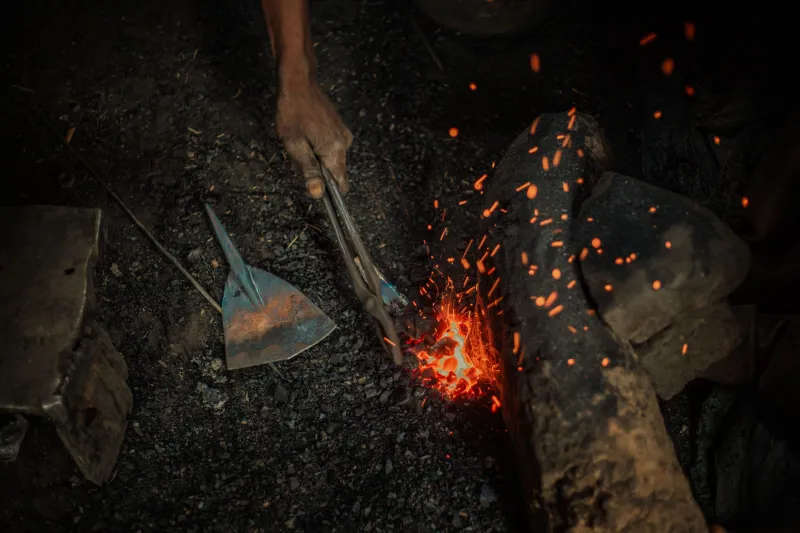
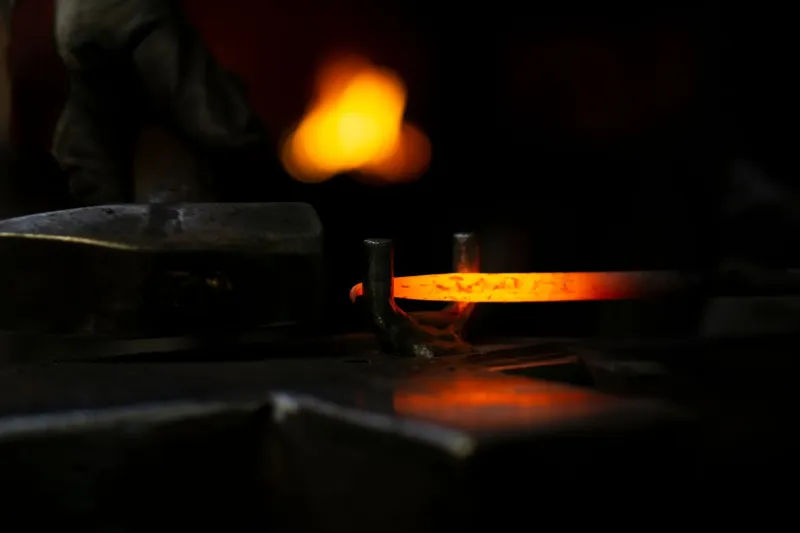
The old blacksmith would polish a section of the tool's surface, then hold it near the edge of the forge fire, watching the colors crawl across the steel from the heat source outward. The moment the right color reached the cutting edge, the tool went into the quench. That split-second timing — developed through years of repetition — is what separated a mediocre smith from one whose tools got handed down through three generations.
Modern factories skip this entirely. Oven tempering is uniform and repeatable, which sounds great until you realize that uniform treatment applied to non-uniform steel stock produces non-uniform results. Hand-tempering, paradoxically, allowed a skilled smith to compensate for variation in the steel by adjusting the process to fit the material.
Quench Media: Water, Oil, and Everything In Between
The quenching medium — what you dunk the hot steel into — has an enormous effect on the final result. Traditional smiths didn't just grab whatever was handy. They made deliberate choices based on the steel they were working and the tool they were making.
Water quenches fast and hard. It's aggressive. High-carbon steel quenched in water comes out very hard, but the rapid cooling creates internal stresses that can crack or warp the piece. Old smiths used water quenches carefully, often on simpler steel or for tools where maximum hardness was worth the risk. Brine — saltwater — quenches even faster and was sometimes preferred for specific applications.
Oil quenches slower, producing a slightly softer but far more stable result. Canola, lard, motor oil, even old whale oil in earlier centuries — smiths used what they had. A slower quench means less internal stress, fewer cracks, and a tougher finished tool. Most traditional knife-making relied on oil quenching for exactly this reason.
Air cooling is the slowest quench of all, used for certain alloy steels or when a smith wanted a very tough, moderately hard result. Some traditional hatchet heads were finished this way.
For preppers interested in understanding — or attempting — basic tool hardening, canola oil in a metal container is a solid starting point. It's cheap, available everywhere, and forgiving enough for beginners working with high-carbon steel from old files or leaf springs.
Step-by-Step: Basic Tempering for the Curious Prepper
This isn't a full blacksmithing tutorial, but here's the honest framework for anyone who wants to understand the process or try it carefully:
-
Polish a section of your hardened tool near the cutting edge using fine sandpaper. The colors won't show on a rough or oxidized surface.
-
Apply heat slowly and indirectly. A propane torch works for small pieces. Hold the heat back from the edge — let it conduct forward rather than blasting the cutting surface directly.
-
Watch the colors move. They'll travel toward the cooler edge. Know your target color before you start. For a general-purpose camp knife, pull it at golden yellow. For a chopping tool, let it reach light brown.
-
Quench immediately when the color hits your target zone. Don't hesitate.
-
Test carefully. A properly tempered edge will take a sharpening without crumbling and flex slightly under pressure without snapping.
You'll probably ruin a piece or two learning this. That's fine. Every smith who ever got it right ruined plenty of steel getting there.
Why This Matters When the Hardware Store Is Closed
In a genuine survival scenario — extended grid-down, supply chain collapse, whatever your specific concern is — the ability to harden and temper steel from salvaged material is a force-multiplying skill. A worn-out file, an old leaf spring, a broken axle — all of these are high-carbon steel waiting to become a useful tool in the hands of someone who understands the process.
Mass-produced tools are optimized for cost efficiency and consistent performance under normal conditions. Traditional hand-tempering was optimized for durability under unpredictable conditions — because that's all there was. The smith's reputation, and sometimes the customer's survival, depended on getting it right.
There's a reason those old tools keep showing up at estate sales and farm auctions, still functional after a hundred years of use. The people who made them cared about the outcome in ways that a production line simply can't replicate.
Learning to read color, choose your quench, and time your pull isn't just a cool skill to have. It's a connection to the practical knowledge that built this country — and it's exactly the kind of capability that separates someone who's prepared from someone who's just equipped.
The steel doesn't lie. Neither does experience.