Cast Iron, Stone Pits, and Dutch Ovens: The Old Kitchen Gear That Modern Preppers Can't Afford to Ignore
Walk into any outdoor retailer today and you'll find titanium pots that weigh less than a granola bar, battery-powered camp stoves, and smart coolers with Bluetooth connectivity. It's impressive stuff. It's also exactly the kind of gear that fails you when the power's out, the batteries are dead, and you're trying to feed your family on day four of a grid-down situation.
Meanwhile, there's a cast iron skillet in some grandmother's kitchen right now that's been cooking meals since the Eisenhower administration. It doesn't need batteries. It doesn't need a firmware update. It just needs heat — and in a survival context, heat is something you can almost always make.
This isn't a rant against modern convenience. It's an argument for having the right tools in the right context. And when the context is long-term preparedness, traditional cooking gear wins more arguments than most people realize.
The Problem With Lightweight and Battery-Dependent
The outdoor industry has spent decades optimizing for one specific use case: the weekend backpacker who wants to shave ounces and be back in the car by Sunday afternoon. That's a legitimate market. But it's not the prepper's market, and conflating the two leads to some genuinely bad gear decisions.
Ultralight cookware — think thin aluminum or titanium — is great for boiling water on a trail. It's terrible for anything requiring sustained, even heat. You can't sear, you can't bake, and you can't slow-cook without scorching everything against the thin walls. The moment you try to do something more complex than rehydrate a freeze-dried meal, you're fighting the gear.
And battery-dependent appliances? In a short-term emergency, sure, they might hold up. But batteries degrade, solar chargers need sun, and propane canisters eventually run empty. A cooking system that depends on any of those things has a built-in expiration date. Traditional tools don't.
Cast Iron: Heavy for a Reason
Let's start with the obvious one. Cast iron cookware has been a staple of American kitchens since before the country was a country. Colonists used it. Frontier families hauled it across the Oregon Trail. Army cooks relied on it through multiple wars. There's a reason it never got replaced — it's genuinely hard to improve on.
The weight that people complain about is actually the feature. That mass is thermal storage. Cast iron holds heat uniformly and releases it slowly, which means you can pull it off a fire and keep cooking with residual heat. It means your cornbread doesn't burn on the bottom while it's still raw on top. It means you can maintain a consistent simmer without babysitting the flame.
Seasoning is the other thing worth understanding. A properly seasoned cast iron pan has a naturally non-stick surface that gets better with every use. It doesn't chip, it doesn't flake, and it doesn't release microplastics into your food. Maintaining a cast iron piece is simple: cook with it, dry it thoroughly, rub a light coat of oil on the cooking surface, and store it somewhere dry. That's it. Do that consistently and the pan will outlive you.
For preppers specifically, cast iron's compatibility with open fire, wood stoves, rocket stoves, and camp setups makes it uniquely versatile. It doesn't care where the heat comes from.
The Dutch Oven: A Survival Kitchen in One Pot
If you could only have one piece of cooking equipment in a long-term grid-down scenario, a camp Dutch oven would be a very defensible choice. These are the heavy, lidded cast iron pots with legs on the bottom and a flanged lid — designed specifically for cooking over and under coals.
The flanged lid is the key innovation. It lets you pile hot coals on top, turning the Dutch oven into a rudimentary oven. You can bake bread, roast meat, make stews, fry, boil, and simmer — all in one vessel, all over a wood fire. Pioneer families used these for everything, and the techniques they developed are remarkably refined.
Coal placement matters more than most beginners expect. As a general rule, you want more heat on top than on the bottom to avoid scorching. A common starting ratio is roughly two-thirds of your coals on the lid and one-third underneath. From there, you adjust based on what you're cooking and how it's responding. Bread and baked goods want gentle, even heat. Stews can handle more aggressive bottom heat.
The learning curve is real, but it's not steep. A few practice sessions with a Dutch oven in your backyard will teach you more about fire-based cooking than any YouTube tutorial.
Stone-Lined Cooking Pits: Older Than Civilization, Still Relevant
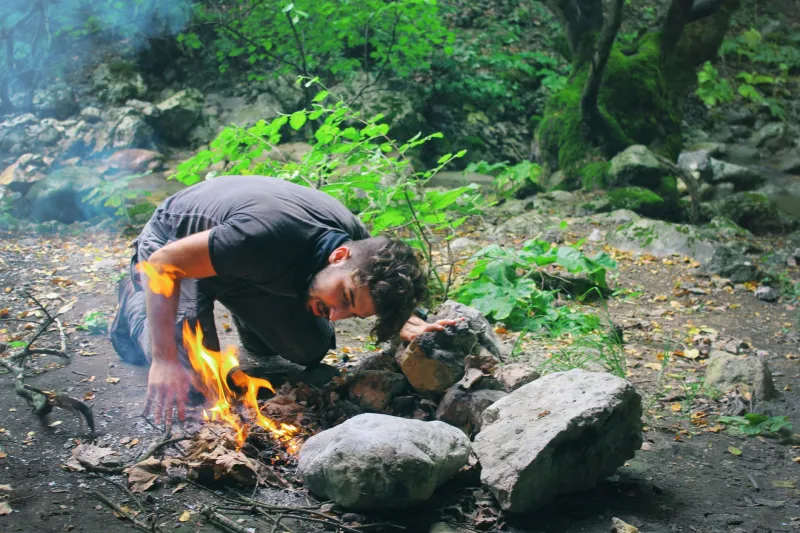
Before metal cookware, people cooked in the ground. Stone-lined pits — sometimes called earth ovens or pit ovens — are one of the oldest cooking technologies in human history, and they're still used in various forms across cultures worldwide. The Hawaiian imu, the New England clambake, the barbacoa pit of northern Mexico — they're all variations on the same ancient idea.
The concept is straightforward: dig a pit, line it with stones that can handle thermal stress (avoid river rocks, which can crack or explode when heated rapidly), build a fire in the pit to heat the stones thoroughly, remove the coals, add your food wrapped in leaves or cloth, cover the whole thing with soil or bark, and let residual heat do the work over several hours.
For survival cooking, pit methods excel at a few specific tasks: cooking large quantities of food at once, slow-cooking tough cuts of meat until they're tender, and doing it all with minimal active fuel consumption. Once the stones are hot, the cooking is essentially free.
It's not a technique for every meal. But for a community-scale cooking situation — feeding a group over an extended period — it's remarkably efficient.
Making the Case for Going Heavy
Here's the bottom line: lightweight, modern cooking gear is optimized for convenience. Traditional cooking tools are optimized for durability, versatility, and independence from manufactured inputs. Those are very different design priorities, and they produce very different results under pressure.
A cast iron skillet that's been in your family for three generations isn't just a cooking tool — it's proof of concept. It's evidence that some things don't need to be improved because they were right the first time.
For preppers and homesteaders building out a serious survival kitchen, the recommendation here is simple: go heavy. Invest in quality cast iron. Get a camp Dutch oven and actually learn to use it before you need to. Understand the basics of pit cooking. These aren't backup options — they're primary tools that happen to also work in normal life.
When the grid's up and everything's fine, your cast iron makes better cornbread than anything else in the kitchen anyway. When things get harder, it becomes something you genuinely can't do without.