No Freezer, No Problem: Rediscovering the Food Preservation Methods That Kept America Fed for Centuries
Power outages used to be an inconvenience. These days, with supply chains showing real fragility and more Americans thinking seriously about long-term food security, they're starting to look like a genuine threat. If the grid went down for a month — not a hurricane weekend, but a real, extended outage — how long would your food supply last?
For most households, the honest answer is uncomfortable. We've built our entire food system around refrigeration, and we've forgotten that people fed themselves just fine without it for thousands of years. Not just survived — thrived. Frontier families, homesteaders, and rural communities across America maintained robust, nutritious food supplies through techniques that required no electricity, no synthetic preservatives, and no special equipment beyond what they could build or buy locally.
Those techniques still work. And right now, more Americans than ever are learning them.
Why Pre-Refrigeration Methods Are Having a Moment
Walk into any serious prepper community — online or in person — and you'll find fermentation crocks sitting next to ammo cans, root cellar diagrams tacked up next to bug-out checklists. There's a reason for that. These skills aren't just about surviving a disaster scenario. They represent a genuine form of independence from systems that have become increasingly unreliable.
Beyond preparedness, there's a nutritional angle that's getting more attention. Many traditional preservation methods don't just maintain food — they actually enhance it. Fermentation, for instance, increases bioavailability of nutrients, introduces beneficial bacteria, and in some cases creates vitamins that weren't present in the original food. Your great-grandmother's sauerkraut was doing things for her gut health that modern nutritional science is only beginning to fully understand.
Let's break down the four main pillars of pre-refrigeration food preservation and what each one looks like in practice.
Fermentation: The Living Preservation Method
Fermentation is arguably the oldest food preservation technique humans have ever used, and it works on a beautifully simple principle: encourage the right microorganisms to outcompete the harmful ones, and your food becomes self-preserving.
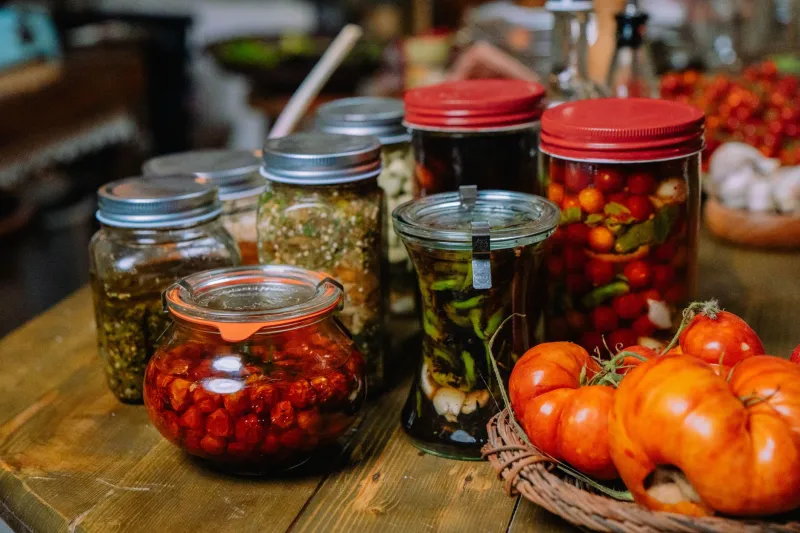
Lacto-fermentation — the kind used for vegetables like sauerkraut, kimchi, and pickles — relies on naturally occurring Lactobacillus bacteria. These bacteria thrive in a salty, anaerobic (oxygen-free) environment and produce lactic acid as they feed on the sugars in the food. That acid lowers the pH of the environment, making it inhospitable to spoilage organisms and pathogens.
Getting started with lacto-fermented vegetables:
- Salt matters. Use non-iodized salt — kosher salt or sea salt both work. Iodine inhibits bacterial activity and can derail your ferment. A general ratio is about 2% salt by weight of your vegetables.
- Keep it submerged. Vegetables must stay below the brine to ferment safely. Use a weight — a zip-lock bag filled with brine works well as an improvised weight in a wide-mouth mason jar.
- Temperature affects timing. Cooler temperatures (60-65°F) produce slower, more complex-flavored ferments. Warmer temperatures (70-75°F) speed things up but can make the result softer and more acidic.
- Trust your senses. A good ferment smells sour and tangy, not putrid. If you see fuzzy mold (not just white kahm yeast on the surface, which is harmless), toss it and start over.
For long-term storage, fermented vegetables kept in a cool environment can last many months. Before refrigeration, families in northern states relied on crocks of fermented cabbage and root vegetables to get through winters when fresh produce was simply unavailable.
Root Cellars: The Original Cold Storage
The earth itself is an insulator. Dig down far enough, and the ground maintains a relatively stable temperature year-round — typically between 40°F and 60°F in most of the continental US. That's exactly the range you need to slow the metabolic processes that cause produce to deteriorate.
A properly built root cellar can keep apples, potatoes, carrots, turnips, beets, onions, and cabbages fresh for months without a single watt of electricity. Homesteaders in the Midwest and Appalachia were feeding families through February on root cellar stores well into the 20th century.
Root cellar basics for modern preppers:
- Location. A north-facing slope is ideal — less solar gain. The cellar should be deep enough that the ceiling sits at least 2 feet below the frost line for your region.
- Humidity control. Most root vegetables want high humidity (85-95%) to prevent shriveling. A dirt floor helps maintain this naturally. Line walls with gravel for drainage.
- Ventilation. You need airflow to prevent ethylene gas buildup (produced by ripening fruit) from accelerating spoilage. Two vents — one low, one high — allow passive air exchange.
- Separate your produce. Apples and pears emit ethylene and will accelerate ripening in nearby vegetables. Store them separately or in sealed containers.
- Pack root vegetables in sand or sawdust. This maintains humidity around each individual vegetable and prevents them from touching, which slows the spread of rot.
If you don't have the land or budget for a full underground cellar, a buried trash can, a hillside cache, or even an insulated box in an unheated garage can provide meaningful cold storage in a pinch.
Salt Curing: Preservation Through Chemistry
Salt is one of the most powerful food preservation tools ever discovered. It works by drawing moisture out of food and microbial cells through osmosis — without water, bacteria simply can't survive or reproduce.
Salt-cured meats were a cornerstone of American food security from colonial times through the early 20th century. Salt pork, country ham, salt cod, and corned beef were staples precisely because they could be stored at room temperature for extended periods without spoiling.
Two primary methods:
Dry curing involves packing meat directly in salt (often mixed with sugar and spices) and allowing it to cure over days or weeks. The salt draws out moisture, creating an inhospitable environment for pathogens. Country ham is the classic American example — a whole hog leg packed in salt and hung to cure for months.
Wet curing (brining) submerges meat in a concentrated salt solution. Corned beef is the most familiar example to most Americans. A basic brine is roughly 1 cup of kosher salt per gallon of water, though recipes vary widely based on the meat and desired outcome.
A note on nitrates: traditional curing salt (Prague Powder) contains sodium nitrite, which inhibits the growth of Clostridium botulinum — the bacteria responsible for botulism. For long-term meat preservation, especially with whole muscles and thick cuts, using proper curing salts isn't optional. It's a food safety requirement.
Smoking: Flavor, Preservation, and Redundancy
Smoke preserves food through a combination of drying, antimicrobial compounds in the smoke itself (phenols, aldehydes, and organic acids), and the creation of a surface barrier that slows recontamination. Used in combination with salt curing, smoking dramatically extends the shelf life of meat and fish.
Cold smoking (under 90°F) flavors and partially preserves but doesn't fully cook the food — it's typically used in conjunction with salt curing. Hot smoking (above 160°F) both cooks and preserves simultaneously and is more accessible for beginners.
A simple smoker can be built from cinder blocks, an old barrel, or even a pit dug in the ground. Hardwoods like hickory, apple, cherry, and oak produce the best smoke for food. Avoid resinous softwoods like pine — the resins create off-flavors and may introduce harmful compounds.
Putting It All Together: A Layered Approach
The most resilient food preservation strategy doesn't rely on any single method. It stacks them. Salt-cure your venison, then smoke it. Ferment your garden vegetables in late summer and move the crocks into the root cellar before the first frost. Dry your herbs and beans for long-term pantry storage. Each method covers different foods and different timeframes, and together they create a food security system that doesn't depend on a single point of failure.
This is exactly how American families operated before the mid-20th century — not because they were survivalists, but because it was the only practical way to eat well year-round. They weren't just getting by. They were building genuine food independence, one crock and one smokehouse at a time.
The knowledge didn't disappear. It just got set aside. And it's worth picking back up.