Striking Fire from Scratch: An Honest Field Test of 5 Primitive Ignition Methods
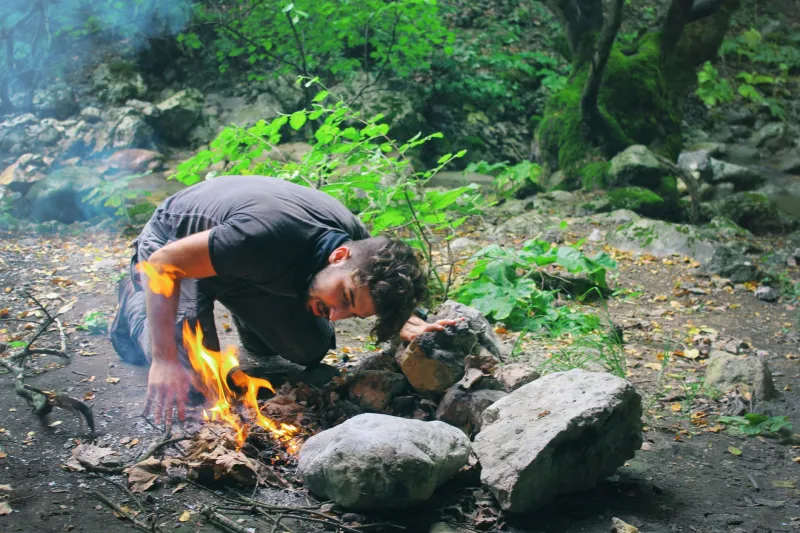
Every survival enthusiast has seen the videos. Some guy in ideal conditions spins a bow drill for thirty seconds, blows gently on a glowing coal, and a cheerful fire erupts like magic. It looks almost easy.
It is not easy.
I've been practicing primitive fire-starting for several years, and I've tested these methods in conditions that are considerably less cooperative than a YouTube studio. Cold mornings in the Ozarks. Humid afternoons in the Southeast. Windy ridgelines where the tinder blows out of your hands before you can even try. What follows is an honest account of how five different ignition methods actually perform — what works, what's overhyped, and what you should realistically have in your kit.
Why This Matters for Preppers
Fire is non-negotiable in a survival scenario. It purifies water, signals rescuers, provides warmth, cooks food, and does a remarkable job of keeping morale from collapsing. Your ability to start one reliably — not just in ideal conditions, but in real ones — could be the difference between a bad situation and a fatal one.
The question isn't whether you can start fire without a lighter. The question is whether you can do it consistently, quickly, and with whatever materials the environment hands you. That's the standard we're testing against.
Method 1: The Bow Drill
Reliability Rating: 7/10 | Learning Curve: High
The bow drill is the gold standard of friction fire. A carved fireboard, a spindle, a bow strung with cordage, and a handhold piece — that's the whole system. The bow drives the spindle in a rotational motion against the fireboard, generating fine black dust that eventually forms a glowing coal.
In dry conditions with matched wood species (cottonwood, cedar, and willow are popular choices in the US), an experienced practitioner can get a coal in under a minute. That's genuinely impressive.
But here's the honest part: moisture is this method's enemy. After two days of rain in Tennessee, I spent nearly twenty minutes on a bow drill before getting a coal — and I've been doing this for years. The wood absorbs humidity fast, and no amount of technique compensates for wet materials. You can dry your fireboard over a small fire first, but that assumes you already have fire, which is a circular problem.
The bow drill rewards dedicated practice. If you've put in the hours, it's a capable method. If you haven't, it will frustrate you at the worst possible moment.
Method 2: The Hand Drill
Reliability Rating: 5/10 | Learning Curve: Very High
The hand drill ditches the bow entirely. You spin the spindle between your palms, applying downward pressure as your hands drift toward the fireboard, then quickly reposition and repeat. It's more portable — just a spindle and a board — but demands significantly more technique and physical conditioning.
I'll be direct: the hand drill is a punishing method for beginners. Your hands need calluses. Your form needs to be close to perfect. And your wood selection needs to be spot-on — mullein and cattail stalks against a dry willow or basswood board are a reliable pairing if you can find them.
In warm, low-humidity conditions, I've had good success. In cool weather, the challenge scales up dramatically because your hands lose dexterity and the wood doesn't generate heat as efficiently. This is a beautiful skill to develop, but I wouldn't stake my survival on it without hundreds of hours of practice behind me.
Method 3: The Fire Plow
Reliability Rating: 4/10 | Learning Curve: Moderate
The fire plow involves carving a groove into a softwood base and driving a hardwood peg back and forth along it, pushing accumulated dust to the end of the groove until it ignites. It's simpler mechanically than the bow drill and requires no cordage.
In honest testing, the fire plow is exhausting and inconsistent. It demands a lot of physical effort for a lower success rate than the bow drill, particularly in anything other than ideal conditions. That said, it has a real advantage: it's intuitive. Someone who's never done friction fire before can grasp the concept immediately and potentially succeed on their first real attempt — which puts it ahead of the hand drill for pure beginner accessibility.
I'd consider this a backup method or a teaching tool, not a primary technique.
Method 4: Natural Tinder and Spark Methods (Flint and Steel)
Reliability Rating: 8/10 | Learning Curve: Moderate
Striking a high-carbon steel against sharp flint produces a spark hot enough to ignite a prepared tinder bundle — char cloth, dried fungi, or finely processed plant fiber. This is the method that bridged the Stone Age and the Iron Age, and it still holds up.
The variables here are the tinder and the char cloth. Char cloth (partially burned cotton or linen fabric, stored in a tin) catches sparks with remarkable consistency. The challenge is preparation — you need to make it ahead of time. Natural alternatives like amadou (from horse hoof fungus) or dried cattail fluff work well but require knowing what you're looking for in the field.
In testing across multiple conditions, flint and steel with good char cloth was one of the most reliable non-modern methods I tested. It's slower than a ferrocerium rod but uses entirely natural or primitive materials, making it a genuine wilderness skill rather than a gear dependency.
Method 5: Ferrocerium Rod
Reliability Rating: 9/10 | Learning Curve: Low
Okay, yes — a ferro rod is modern technology. But it belongs in this comparison because it represents the practical bridge between primitive knowledge and contemporary preparedness. A quality ferro rod throws sparks at over 3,000°F, works when wet, and lasts for thousands of strikes. It's also small, light, and costs less than a decent lunch.
Paired with well-prepared natural tinder — dry birch bark shavings, fatwood dust, dried grass bundles — a ferro rod is brutally effective. The limiting factor isn't the ignition source; it's your tinder preparation. And that's actually the right lesson: tinder preparation is the foundational skill that makes every fire-starting method work better.
If you're building a survival kit, a ferro rod should be in it. Non-negotiable.
What the Testing Actually Taught Me
After running all five methods across different conditions and seasons, a few things became clear:
Tinder preparation is everything. The gap between a method that works and one that doesn't is almost always in the tinder bundle. Invest time learning to process natural tinder — it pays dividends across every ignition method.
Moisture changes the game. Methods that feel easy in dry summer conditions become serious challenges after rain. Build your skills in adverse conditions, not just comfortable ones.
Carry redundancy. A ferro rod and a practiced bow drill skill together is a far more robust system than either one alone. Layered redundancy is the prepper mindset applied to fire.
Practice regularly. Friction fire skills decay without use. If you learned the bow drill two years ago and haven't touched it since, assume you'll struggle when it matters.
Fire is primal. It's been central to human survival for hundreds of thousands of years. Learning to make it from scratch — really learning it, not just watching a video — is one of the most grounding, confidence-building things a prepper can do. Start with a ferro rod, work toward the bow drill, and never stop refining your tinder game. The wild doesn't care about your excuses.