Why Your Arm Gives Out Before Your Will Does: The Truth About Tool Balance in a Survival Situation
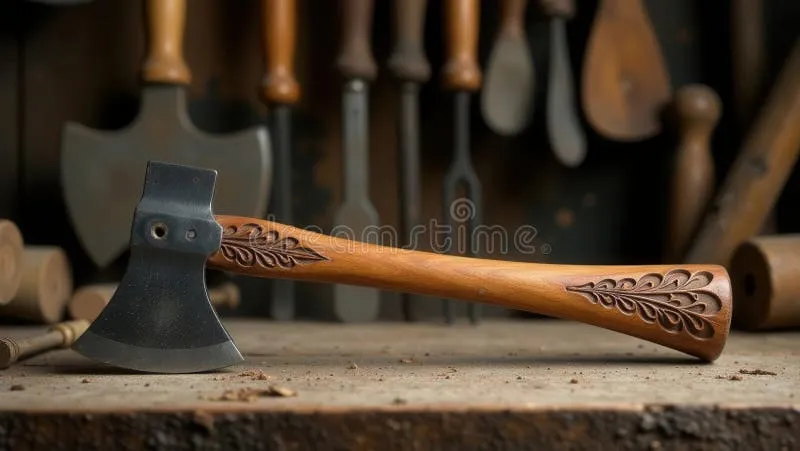
Photo: vintage hand-forged axe and tools on wooden workbench outdoors, via thumbs.dreamstime.com
There's a moment every serious outdoorsman eventually hits. You're deep into a task — splitting wood, digging a fire pit, clearing brush — and your grip starts to fail. Not because you're weak. Not because you gave up. But because the tool in your hand has been quietly working against you for the last two hours, and your body finally sent the bill.
Most folks chalk it up to being out of shape or just plain tired. But here's the thing: a well-balanced tool shouldn't drain you like that. The real culprit is almost always weight distribution, and it's a problem that modern manufacturers have been making worse for decades while dressing it up in carbon fiber handles and matte black finishes.
Physics Doesn't Care About Your Brand Loyalty
Let's start with the basics, because this stuff matters and it's not complicated once you see it laid out.
Every tool has what engineers call a center of mass — the point where the weight is effectively concentrated. When that point lines up close to your hand, your muscles spend most of their energy doing useful work. When that point is way out near the business end of the tool, your muscles spend a huge chunk of their energy just holding the thing up against gravity before you've even swung it.
Think about a cheap big-box-store axe versus a properly balanced hand-forged felling axe from a century ago. The modern version often has a thick, heavy poll, a dense synthetic handle, and a head that sits awkwardly far from where the weight wants to be. Every swing, you're fighting a lever arm that's working against your wrist, elbow, and shoulder. Do that five hundred times in a single afternoon and you're not just tired — you've got the groundwork laid for a repetitive strain injury that could sideline you at exactly the wrong moment.
Old-timers understood this intuitively. They lived and worked with their tools every single day, and a badly balanced implement didn't just slow you down — it cost you money, crops, and in hard times, survival itself. So they refined these designs over generations until they got it right.
Where Modern Manufacturers Went Wrong
Walk through any outdoor or hardware retailer in America and you'll notice something: the tools look impressive. Sleek profiles, aggressive styling, ergonomic-looking grips with rubberized textures and finger grooves. But looking ergonomic and being ergonomic are two very different things.
A lot of current production tools are designed with the retail shelf in mind. They need to photograph well. They need to feel substantial in a thirty-second in-store test. Nobody's standing in the aisle swinging a shovel for four hours to see how their lower back feels about it.
The result is tools that front-load their weight — heavy heads, light handles — which gives that satisfying heft in the store but turns into punishment in the field. Shovels with thick steel blades and hollow fiberglass handles. Hatchets with oversized heads that torque your wrist on every glancing blow. Even mauls and mattocks that are technically functional but require you to muscle through every stroke instead of letting geometry do the work.
Contrast that with a vintage hand-forged garden mattock or a properly hafted felling axe from the early 1900s. The heads are often lighter than their modern counterparts, but the handle taper, length, and hang angle are tuned so that the swing arc feels almost effortless. You're not fighting the tool. You're guiding it.
What Exhaustion Actually Does to Your Technique
Here's where survival stakes get real. When you're well-rested and well-fed, bad tool balance is annoying. When you're running a caloric deficit, haven't slept right in two days, and your hands are cold — bad tool balance becomes genuinely dangerous.
Fatigue degrades your grip strength faster than almost any other factor. Once your grip goes, your swing mechanics fall apart. You start compensating with your back instead of your hips and shoulders. Glancing strikes become more likely, and a glancing strike with an axe or a heavy digging tool can do serious damage to your foot, your leg, or your off hand.
A well-balanced tool gives you a longer window before fatigue starts corrupting your form. That window could mean the difference between getting your shelter built before dark or still being exposed when temperatures drop.
How to Test Your Gear Right Now
You don't need a physics lab to assess the tools you already own. Here are three quick field tests you can do in your backyard this weekend.
The Hang Test. Hold the tool loosely by the very end of the handle and let it hang freely. A well-balanced axe or hatchet should hang with the bit angled somewhere between 20 and 35 degrees below horizontal. If the head drops nearly straight down, the balance point is too far forward and your wrist is going to pay for it.
The Choke Test. Grip the tool near the head — way up the handle — and do a slow, controlled swing motion. Notice where the weight wants to pull. Then slide your grip back to the normal position and repeat. If the tool feels dramatically heavier and more unwieldy at the proper grip point, that's a sign the weight distribution is fighting your natural mechanics.
The Two-Hour Simulation. This one's simple and brutal. Pick a repetitive task — splitting kindling, turning soil, chopping brush — and do it for a solid two hours with the tool in question. Then note where you feel it. If the fatigue is concentrated in your wrist, elbow, or the small stabilizing muscles of your forearm rather than your larger muscle groups, the balance is off. Properly distributed tools let the big muscles of your shoulder and core do most of the work.
What to Look For When You're Buying
When you're shopping for axes, shovels, mattocks, or any long-handled striking or digging tool, train yourself to ignore the flashy stuff and focus on a few practical details.
Handle length matters enormously. A handle that's too short forces you to hunch and rob yourself of swing arc. Too long and you lose control. Traditional handle lengths weren't arbitrary — they were calibrated to average human proportions and the specific mechanics of each task.
Handle taper and material affect vibration transmission and grip security. Straight-grain American hickory, the traditional standard for quality tool handles, absorbs shock better than most synthetics and allows you to feel what the tool is doing through the wood. That feedback matters when you're working in low light or fatigued conditions.
Head geometry, particularly the hang angle on axes and hatchets, determines how the edge presents at impact. A tool with proper hang hits squarely with a natural swing. One with poor hang requires constant micro-corrections that add up to significant fatigue over time.
The Bottom Line
Your survival kit is only as good as your ability to use it when things get hard. And things getting hard means you're tired, stressed, and probably a little banged up. That's exactly when your tools need to be working with your body, not against it.
The craftsmen who built the great American tool-making tradition weren't just skilled — they were practical. Every curve, every taper, every grain orientation in a hickory handle was there for a reason. When you pick up a tool built on those principles, you're not buying nostalgia. You're buying the accumulated wisdom of people who couldn't afford to get it wrong.
Learn to read your gear. Your grip strength and your lower back will thank you for it.