Shaken to the Bone: What Repetitive Tool Vibration Does to Your Hands—And Why Primitive Tools Were Built Different
You don't feel it happening. That's the worst part. Every time you run a chainsaw, a reciprocating saw, or an angle grinder, the vibration moving through the handle and into your palm isn't just noise—it's cumulative damage stacking up in your tendons, nerves, and blood vessels. By the time your fingers start going numb or your grip starts failing, the injury is already years old.
For preppers and outdoor enthusiasts who depend on their hands to survive, this isn't just an occupational health footnote. It's a threat to your entire plan.
The Medical Reality Nobody Talks About
Hand-Arm Vibration Syndrome—HAVS for short—is a recognized occupational disease that attacks workers who use vibrating tools regularly. According to the National Institute for Occupational Safety and Health (NIOSH), symptoms include tingling and numbness in the fingers, blanching (whitening) of the fingertips triggered by cold, reduced grip strength, and in advanced cases, permanent nerve damage and vascular injury. The condition is progressive and largely irreversible once it takes hold.
Arthritis follows a similar pattern. Repetitive micro-trauma from vibrating tools accelerates cartilage breakdown in the small joints of the hand. Surgeons who work with tradespeople see it constantly—men and women in their forties and fifties with the hand X-rays of someone twenty years older.
Now think about your bug-out plan. If your survival strategy leans heavily on power tools during a grid-down scenario—a gas-powered generator running a circular saw, a battery-powered drill you've stockpiled—you may be trading long-term hand function for short-term convenience. And in a prolonged crisis, your hands are the most important tools you own.
What the Blacksmiths Actually Know
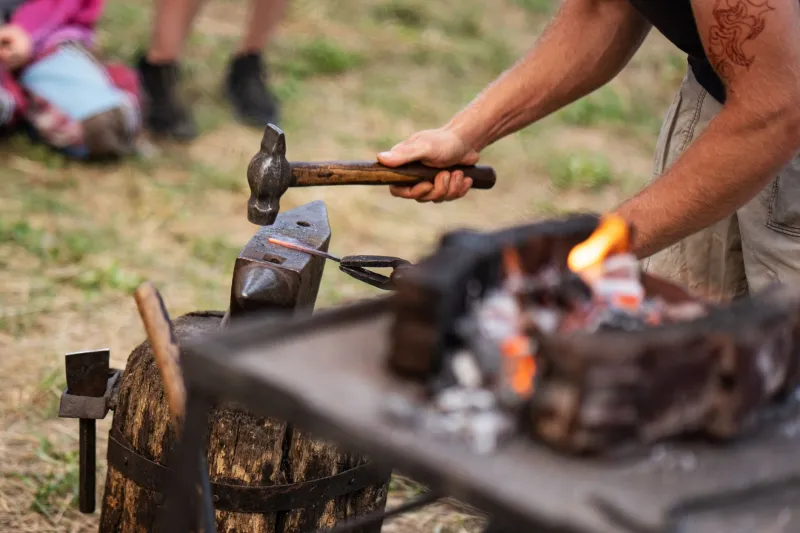
Spend an afternoon with a working blacksmith and the conversation eventually turns to tool design. Not the aesthetics—the ergonomics. Why handles are shaped the way they are. Why certain woods were chosen for hafts. Why the weight of a hammer head sits where it does.
Old-school blacksmiths who still work traditionally will tell you the same thing: a well-balanced hammer almost swings itself. The weight distribution means the tool does the work, not your wrist. You're guiding it, not forcing it. That distinction matters enormously over the course of a long day—or a long crisis.
Hand-forged tools built in the traditional manner tend to have a few specific properties that modern mass-produced tools often sacrifice for cost or manufacturing convenience.
Natural material handles absorb shock. Hickory, ash, and osage orange—the traditional American choices for tool handles—have a grain structure that flexes slightly under impact. That flex dissipates vibration before it reaches your palm. Fiberglass and plastic handles transmit vibration more efficiently, which sounds like a feature until you realize your hand is on the receiving end.
Weight distribution reduces effort and impact. A properly balanced hand-forged axe or hammer puts the mass where it needs to be for the task. You're not fighting the tool. Less fighting means less grip tension, less fatigue, and far less repetitive strain.
Slower tools mean less vibration frequency. A hand-cut saw, a draw knife, a hand plane—these tools operate at human speed, not motor speed. The vibration frequency is dramatically lower than any power tool, which is exactly what keeps HAVS from developing. Your nervous system simply isn't being hammered at the frequencies that cause damage.
Field Medics Weigh In
Talk to anyone who's worked as a field medic or combat medic and they'll confirm something that doesn't get enough attention in prepper circles: hand injuries are among the most disabling in a field environment. A broken finger or a compressed nerve in your palm doesn't just hurt—it takes you offline. Tasks that require fine motor control become impossible. Fire-starting, suturing, knot-tying, trigger operation—all of it degrades.
Field medics who've worked in austere environments consistently emphasize that hand health is a force multiplier. Protecting your hands before an injury happens is infinitely more valuable than treating one after the fact. And that means being deliberate about what you put in your hands and how you use it.
The practical guidance from the medical side is straightforward: minimize high-frequency vibration exposure, use tools that fit your hand properly, and build in rest before fatigue sets in—not after.
How to Select Tools With Long-Term Hand Health in Mind
When you're evaluating a tool for your preparedness kit, run through these considerations:
Handle material matters more than you think. Prioritize natural wood handles—hickory is the American standard for good reason. It's tough, it absorbs shock, and it can be replaced in the field. If a handle cracks, you can whittle a new one. Try doing that with fiberglass.
Heft the tool before you buy it. Hold it in a working grip and let it hang. Does it feel balanced, or does it feel like the head is pulling your wrist? A well-balanced tool should feel almost neutral in hand. If you're already compensating before you've swung it once, imagine compensating for eight hours.
Consider the task duration. A battery-powered tool might be faster for a one-time job. But if you're building a shelter, processing firewood, or doing extended field work over days, the cumulative vibration load from power tools adds up in a way that hand tools simply don't.
Fit matters. Handle diameter, length, and shape all affect how much grip tension you need to maintain control. A handle that's too thick or too thin forces your hand to work harder than it should. Traditional tool makers sized handles for the work—pay attention to that legacy.
The Bottom Line
Your hands are not replaceable. They're the interface between your knowledge and your survival, and they have a finite number of hours in them. How you spend those hours—and what you put in your grip while you're spending them—determines how long they stay functional.
Modern power tools have their place, but treating them as the default for every task is a decision with long-term consequences that most preppers haven't fully thought through. The craftsmen who built this country's tools weren't working with primitive designs because they didn't know better. They were working with designs that had been refined over generations to keep working people working.
That's not nostalgia. That's engineering.
Take care of your hands. Choose your tools like your grip depends on it—because eventually, it will.