Aches, Pressure, and the Coming Storm: Trusting Your Body Over the Weather App
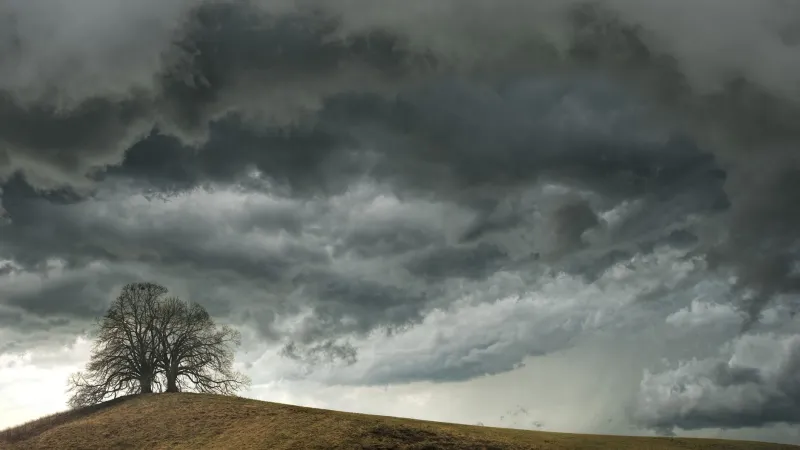
There's a particular kind of old-timer — the kind who spent decades working outside, farming, logging, or trapping — who can feel a weather change coming a day before it arrives. Not because they're psychic. Not because they've memorized some mystical almanac. Because their bodies have been calibrated by years of exposure to the atmosphere, and they've learned to listen.
Modern culture has a tendency to dismiss this as quaint superstition. We have Doppler radar now. We have satellite imagery and seventeen-day forecasts and apps that send push notifications when rain is forty minutes out. Why would anyone trust a sore knee over all that?
Because the knee is right more often than people admit. And because when your communications are down, your power is out, and your phone is dead, the knee is all you've got.
The Biology Behind "I Can Feel It in My Bones"
Atmospheric pressure is real, measurable, and constantly changing. Before a storm system moves in, barometric pressure drops — sometimes dramatically, sometimes gradually, but always detectably. The human body is not sealed against the outside world. Fluid-filled joints, sinuses, and inner ear structures respond to these pressure changes in ways that range from subtle to genuinely painful.
Joint cartilage contains fluid, and that fluid expands and contracts with changes in surrounding pressure. For people with arthritis, old injuries, or surgically repaired joints — where the normal tissue is compromised — this expansion is more pronounced and more painful. The pain isn't imaginary. It's a direct mechanical response to a real physical force.
Sinus cavities work similarly. When outside pressure drops, the air inside your sinuses is temporarily at higher pressure than the surrounding atmosphere. That differential creates pressure, congestion, and sometimes headache. If you've ever noticed your sinuses acting up before a big rain, you weren't imagining it — you were feeling the pressure drop.
The inner ear, which regulates balance and is exquisitely sensitive to pressure changes, can also register incoming weather systems. Some people experience mild dizziness or a sense of "fullness" in their ears before significant storms. Again: real biology, not folklore.
Plant Behavior as a Pressure Gauge
Your body isn't the only natural barometer available to you. Plants respond to atmospheric pressure changes in ways that are observable if you know what to look for.
Many wildflowers — particularly dandelions, scarlet pimpernel, and morning glory — close their petals when pressure drops and rain is incoming. This is a protective response that evolved to protect pollen from moisture. Dandelions are reliable enough that they've been called "the poor man's barometer" in rural American tradition. If your lawn is full of closed dandelion heads on what looks like a clear morning, pay attention.
Leaves on certain hardwood trees — maples are the classic example — will visibly curl or turn their undersides upward before significant rain. This happens because the undersides of leaves have more stomata (tiny pores), and the plant is responding to the increased humidity that precedes storm systems by maximizing transpiration. It's not magic. It's plant physiology doing exactly what it evolved to do.
Moss and lichen absorb moisture from the air and become noticeably softer and more pliable as humidity rises ahead of rain. Run your hand over a mossy rock or log on a supposedly clear day — if it feels unusually damp and spongy, the air is already loading with moisture that hasn't fallen yet.
Reading the Air Itself
Humidity changes are detectable by human senses in ways we've largely trained ourselves to ignore. The smell of rain before it arrives — petrichor, the compound released by wet soil — can travel significant distances ahead of a storm system. If you catch that earthy, mineral smell and the sky is still clear, the front is closer than it appears.
Smoke behavior is another reliable indicator. On high-pressure, stable days, campfire smoke rises cleanly and disperses quickly. As pressure drops ahead of a storm, the atmosphere becomes less stable and smoke tends to sink, swirl, and hang low to the ground. Old-timers watched their chimney smoke the same way modern meteorologists watch pressure charts — because it's telling the same story.
Sound travels differently in high-humidity, low-pressure conditions. You may notice that distant sounds — a highway, a train, a neighbor's equipment — seem louder or clearer than usual. The expression "sound carries before rain" is grounded in real acoustic physics. If the world suddenly sounds more present, check your other indicators.
Building Your Own Baseline
None of these signals work in isolation, and none of them replace developing your own baseline awareness over time. The old-timers who were genuinely reliable at weather prediction weren't relying on any single indicator — they were synthesizing dozens of inputs simultaneously, based on years of observation in a specific place.
That's the key that often gets left out of these conversations: location matters enormously. Weather patterns in the Ozarks behave differently than weather patterns in the Pacific Northwest or the Florida panhandle. The plant indicators that work in the upper Midwest may not be present in the Southwest. Your body's responses to pressure changes are real everywhere, but the timing and severity of those changes vary by region and season.
Start keeping a simple weather journal. Note what your body is telling you — joint stiffness, sinus pressure, ear fullness — alongside actual weather outcomes. Note what the plants on your property are doing. Note smoke behavior, sound quality, animal behavior (livestock and pets are often restless before storms). After a season of consistent observation, patterns will emerge that are specific to your land and your body.
Why This Matters for Preppers
A grid-down scenario doesn't just cut your power and your internet — it cuts your access to weather forecasting at exactly the moment when weather information becomes most critical. Knowing that a severe cold front is incoming before it arrives means the difference between having firewood staged and being caught short. Knowing a multi-day storm is building gives you time to secure shelter, move animals, and top off water storage before conditions deteriorate.
The old homesteaders didn't have the luxury of ignoring these skills. They developed them out of necessity and passed them down as practical knowledge — not superstition, not folk magic, but accumulated observation refined into reliable prediction.
Your body is already collecting data. Your land is already broadcasting signals. Learning to read them isn't a step backward — it's building a redundant system that works when every other system fails. And in preparedness, redundancy isn't paranoia. It's wisdom.