What the Old-Timers Knew: Reading the Forest for Edible Mushrooms Without a Single Guidebook
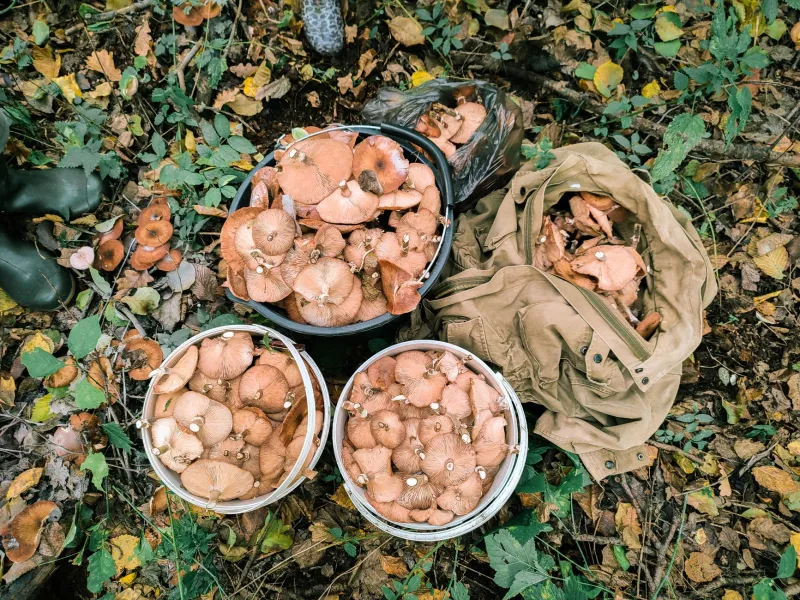
There's a reason experienced foragers talk about mushrooms the way old ranchers talk about weather. You don't learn it from a book. You learn it by being out there — repeatedly, across seasons, in different terrain — until the forest starts making sense in a language that doesn't have words. That kind of knowledge is exactly what primitive-era people relied on, and it's exactly what modern preppers should be building right now, long before they ever need it.
This isn't an article telling you to throw away your field guides. It's an article about developing the deeper layer of knowledge that makes those guides actually useful — the habitat awareness, seasonal instincts, and sensory literacy that experienced foragers have carried in their heads for centuries. That's the foundation. Everything else is detail.
The Habitat-First Mindset
Most beginners make the same mistake: they go looking for mushrooms. Experienced foragers go looking for conditions. Mushrooms are the result of a specific combination of tree species, soil type, moisture level, temperature range, and organic decay. Learn to read those conditions and you'll find yourself walking straight to productive spots without consciously searching.
Take chanterelles as an example. Across much of the eastern US, these golden beauties show up in mature hardwood forests — particularly under oaks, beeches, and hickories — during the warm, wet stretch between late June and early September. They favor slightly acidic, well-drained soil and tend to cluster near moss. Once you've found a chanterelle patch, that patch will likely produce year after year. Traditional foragers knew their spots the way farmers knew their fields.
In the Pacific Northwest, you're working with a completely different palette. Douglas fir, hemlock, and Sitka spruce create the damp, cool understory where species like lobster mushrooms, matsutake, and golden chanterelles thrive. Out on the Great Plains, morel hunters key in on dying elms and the edges of creek bottoms in spring. Every region has its own logic, and learning that regional logic is the real curriculum.
Seasonal Timing as a Safety Net
One of the most underappreciated safety tools in traditional foraging isn't a visual identification trick — it's timing. Knowing when a species fruits dramatically narrows the field of what you're likely to encounter. Most dangerous lookalikes don't share the same seasonal window as their edible counterparts.
Morels, for instance, fruit in early spring across much of the country, typically when soil temperatures hit around 50°F and daytime highs are in the 60s. The false morel (Gyromitra species) does overlap in timing and superficially resembles the real thing — but a careful look at the cap structure tells the story. True morels have a hollow, pitted cap that's fully attached to the stem. False morels have a wrinkled, brain-like cap that's often saddle-shaped and only partially attached. Traditional foragers learned this distinction not from a diagram but from handling hundreds of specimens over many seasons.
Chicken of the woods (Laetiporus species) is a great entry point for beginners because it fruits in a fairly predictable window — late summer through fall — and has no truly dangerous lookalike in North America. It's bright orange-yellow, grows in overlapping shelf-like clusters on dead or dying hardwoods, and has a texture that genuinely resembles shredded chicken when cooked. It's one of the species where habitat, appearance, and timing all stack up in your favor.
Sensory Literacy: What Your Nose and Fingers Are Telling You
Modern foraging culture leans heavily on visual ID, but traditional knowledge incorporated the full sensory picture. Smell, texture, spore color, and even taste (carefully, with small amounts that are spit out) were all part of the identification process.
The death cap (Amanita phalloides) and its relatives — responsible for the majority of fatal mushroom poisonings worldwide — have a faint, sweet, honey-like odor that experienced foragers learn to recognize as a warning flag on any Amanita species. The destroying angel (Amanita bisporigera), pure white and deceptively clean-looking, has almost no smell at all, which is itself a useful data point when you're comparing it to the puffballs it's sometimes confused with. True puffballs, when sliced open, are pure white and featureless inside. A destroying angel button, sliced open, will show the outline of the developing cap and gills — the so-called "egg" structure. That single cross-section check has saved lives.
Spore prints are another traditional tool that require nothing but time and a piece of paper. Place the cap gill-side down, cover it, and wait a few hours. The color of the resulting print — white, brown, black, rust, or pink — is a consistent identifier that helps confirm what you think you're looking at. It's low-tech, reliable, and completely free.
Building the Knowledge Base Without Risking Your Life
Here's the honest prepper calculus: you do not want to be learning mushroom ID for the first time in a survival situation. That's not how this skill works. The traditional approach was cumulative — children learned from elders over years of low-stakes outings, building a mental library of confirmed species before ever relying on that knowledge for sustenance.
You can replicate that process deliberately. Start with three or four species that are genuinely hard to confuse in your region. Morels in the Midwest and East. Chanterelles across most of the country. Chicken of the woods nationwide. Giant puffballs in open fields and forest edges. Learn those species cold — across multiple seasons, in multiple locations, at multiple stages of development. Don't move on until you could identify them in the dark by smell alone.
Join a regional mycological society. Most states have at least one, and their group forays are essentially free apprenticeships. You'll be walking with people who've been doing this for decades, and that kind of direct knowledge transfer is exactly what the old-timers had. It's not glamorous, but it works.
Keep a foraging journal. Note the date, location, tree species nearby, soil conditions, weather in the preceding week, and what you found. Over a few seasons, patterns emerge that no field guide can fully capture — because those patterns are specific to your terrain.
The Mindset That Keeps You Safe
Every experienced forager lives by some version of the same rule: when in doubt, leave it out. That's not timidity — that's wisdom earned through understanding just how consequential a mistake can be. Amatoxin poisoning from death caps doesn't announce itself for 6 to 24 hours after ingestion, by which point serious liver damage is already underway. There is no antidote. The traditional caution around mushrooms wasn't superstition — it was hard-earned respect for a kingdom of organisms that plays by its own rules.
Build your knowledge slowly. Verify repeatedly. Eat what you're certain about. Leave everything else alone until you're more certain.
The forest has been feeding people on this continent for thousands of years. That knowledge is still out there, encoded in the landscape itself, waiting for anyone patient enough to read it. You don't need a guidebook to start. You need time, attention, and the discipline to learn before you need to survive.