When Your Hands Give Out: Building the Grip Strength and Tool Sense That Carry You Through Day Ten
Day one of a survival situation, you feel capable. Motivated, even. The adrenaline is doing its job, your muscles are fresh, and the work — chopping, building, hauling — feels manageable.
By day three, your forearms are screaming. By day five, your grip is unreliable. By day ten, if it gets that far, you're making decisions about which tasks are worth the pain and which ones you'll skip — and skipping the wrong one could kill you.
Hand and forearm endurance is the unglamorous foundation of long-term survival capability, and it's almost never discussed seriously in prepper circles. We talk about the tools. We talk about the skills. We rarely talk about whether our bodies can actually sustain the physical demands of primitive-level work across days and weeks rather than hours.
That conversation is overdue.
What Actually Happens to Your Hands Under Real Load
The human hand is an extraordinary piece of engineering — 27 bones, 29 joints, more than 30 muscles — but it wasn't designed for the specific repetitive stress of sustained tool work. Chopping wood, drawing a saw, working a drawknife, pounding stakes — these movements load the same tendons and muscle groups over and over in ways that modern hands, accustomed to keyboards and touchscreens, handle poorly.
The physiological failure sequence looks like this: muscle fatigue comes first, reducing grip force and control. Then the tendons — particularly in the forearm extensors and the carpal tunnel region — begin to accumulate micro-stress. Blisters form at friction points, compromising grip and opening the door to infection. In cold or wet conditions, all of this happens faster.
The result is that your ability to use tools accurately and safely degrades well before your willpower does. You can want to keep working long after your hands are actually capable of doing it safely. That gap — between what your mind is willing to do and what your hands can reliably execute — is where accidents happen. Axe slips. Knife cuts in the wrong direction. A load dropped at the wrong moment.
The Problem With Modern Ergonomic Design
Here's a counterintuitive truth: a lot of the ergonomic tool design that works well in a workshop or on a job site actually fails in sustained primitive conditions.
Modern ergonomic handles are typically designed to reduce fatigue in short, repetitive work sessions — the kind of use patterns you'd see in a factory or a construction crew. They assume that the user takes breaks, has access to varied tasks, and isn't working through blisters, cold, or caloric deficit.
In a genuine survival scenario, none of those assumptions hold. The soft rubberized grips that feel comfortable in the store can become slippery when wet or muddy. The anatomically contoured handles that fit perfectly in a normal grip become awkward when your hands are swollen from cold or wrapped in improvised bandaging. The lightweight composite materials that reduce fatigue in light use can feel unstable and imprecise when you're driving real force into resistant material.
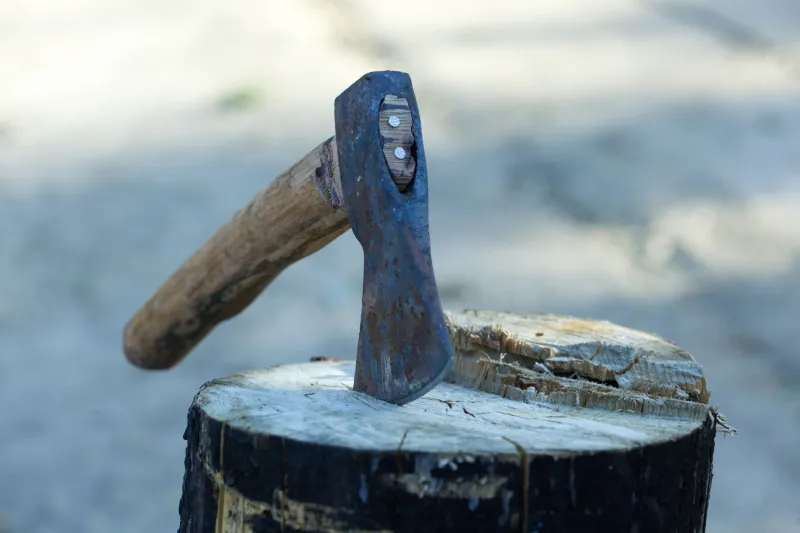
Older tool designs — straight hickory handles, traditional octagonal hatchet helves, simple wooden handles with no contouring — often outperform modern ergonomic designs in extended primitive use. Not because they're more comfortable, but because they're more adaptable. A straight handle can be re-gripped at any point along its length. It can be wrapped with cordage to adjust diameter. It can be replaced in the field with a branch if it breaks. The modern ergonomic handle gives you one grip position and one option when it fails.
Evaluating Your Tools Before You Need Them
The best time to find out your axe handle is wrong for your hand is not when you're on hour six of splitting firewood in November.
Here's a simple field test: take your primary survival tools out for a real two-hour work session. Not a demonstration, not a light test swing — actual work. Split wood with the axe. Saw through a log with the handsaw. Drive stakes with the mallet. At the end of that session, note where the discomfort is concentrated. Hot spots on the palm mean the handle diameter is wrong. Pain at the base of the thumb often indicates too much lateral movement in the grip, which means the handle profile isn't matching your natural swing mechanics. Forearm pump that sets in quickly suggests you're gripping too hard to compensate for a handle that doesn't feel secure.
These are solvable problems. A handle that's too thin can be built up with wrapped cordage or leather. One that's too smooth can be given texture with a file or coarse stone. The balance point of a tool can often be adjusted by trimming the handle or adding weight near the head.
The goal is a tool that you grip lightly but confidently — one that feels like an extension of your arm rather than something you're fighting to control.
Building the Hands You Actually Need
Conditioning your hands for sustained tool work is straightforward, but it takes time and consistency. There are no shortcuts worth taking.
Grip endurance over grip strength. Most people who train grip focus on maximum force — how hard they can squeeze. Survival tool work demands something different: the ability to maintain moderate grip force across hours of use. Dead hangs from a pull-up bar, farmer's carries with heavy loads, and extended sessions with hand tools all build this kind of endurance in ways that grip squeezers and wrist curls don't.
Skin conditioning matters. Calluses aren't just cosmetic. They're functional armor against the blisters that will otherwise sideline your hands in days. Build them gradually through regular tool use. Don't remove them. Moisturize them at night to keep them supple rather than cracked — cracked calluses are actually more vulnerable than soft hands.
Practice tool use in bad conditions. Work with your tools in cold weather, with wet hands, while wearing work gloves. These conditions change everything about how a tool handles, and your first experience with them shouldn't be an emergency.
Rest is part of the strategy. In a sustained survival scenario, protecting your hands is as important as using them. Learn to switch grip positions. Alternate tools when possible to vary the load pattern. Wrap blisters early, before they tear open. A hand that's out of commission isn't just a personal problem — it's a threat to everyone depending on you.
The Long Game
Survival planning tends to focus on Day One readiness — the bug-out bag, the first 72 hours, the immediate crisis. That's important. But the people who actually make it through extended grid-down or wilderness survival situations aren't just the ones with the best gear on Day One. They're the ones whose bodies hold up when the calendar turns to Day Eight, Day Twelve, Day Twenty.
Your hands are at the center of that. Train them, protect them, and build your toolkit around their real-world limitations. The tools that fit your hands, the conditioning that keeps them functional, and the self-awareness to recognize when they're reaching their limit — that's the edge that doesn't show up in any gear catalog.
Forge the hands first. Everything else follows.