Ground Truth: What Every Prepper Needs to Know About Reading Animal Sign
There's a reason the best old-time trappers were quiet men. Not shy — quiet. They'd walk into a woodlot, stand still for a minute, and know more about what was living there than most modern hunters could figure out with a week's worth of trail camera footage. That knowledge didn't come from technology. It came from paying attention to things most people step right over.
Tracks are the obvious starting point, but experienced woodsmen will tell you tracks are almost the last thing they look at. Tracks fade. Tracks lie. A single set of prints in soft mud tells you an animal passed through — nothing more. The real story is written in a dozen other signs that most folks never learn to read.
Scat: The Field Report You're Ignoring
Animal droppings are one of the richest sources of information in the woods, and almost nobody pays serious attention to them. Fresh scat — still dark, moist, and without insect activity — tells you the animal was there recently. Dry, crumbling, sun-bleached scat is old news. But beyond freshness, the content tells you what the animal has been eating, which tells you where it's been spending time.
Whitetail deer scat full of soft, dark pellets means they've been hitting lush browse — likely field edges, creek bottoms, or recent clear-cuts. Hard, dry pellets suggest a diet of woody browse and mast — they're working the oaks and deeper timber. Coyote scat loaded with berry seeds puts them in the thickets and brushy draws. Hair and bone fragments shift them to active predation zones.
Location matters just as much as content. Repeated deposits in the same general area — what trackers call a "latrine site" — signal a regular travel corridor or a territorial boundary. That's not random. That's a location worth setting a trap or a stand.
Browse Patterns: The Grocery List Left Behind
Deer, rabbits, and most browsers leave distinctive feeding sign that persists long after tracks have weathered away. Deer don't have upper front teeth, so they tear rather than cut — a clean, angled snip on a twig means rabbit or squirrel; a ragged, pulled-looking break means deer. Once you train your eye to see that difference, you start reading every shrubby edge differently.
Pay attention to height. Deer browse typically runs from knee height to about five and a half feet. Anything above that on a soft-barked tree is likely elk country if you're in the West, or moose habitat in the northern states. Consistent browsing pressure at the same height across multiple plants tells you not just that animals are present, but roughly how many and how often they're feeding through.
Rubbed saplings — the bark stripped away in vertical patches — are deer sign that most hunters recognize, but the details get overlooked. Fresh rubs are pale, almost white, with wood chips still on the ground beneath them. Old rubs are darkened and weathered. Multiple rubs in a concentrated area, especially on larger-diameter trees, signal a dominant buck with a territory worth watching.
Bedding Areas: Where Animals Feel Safe
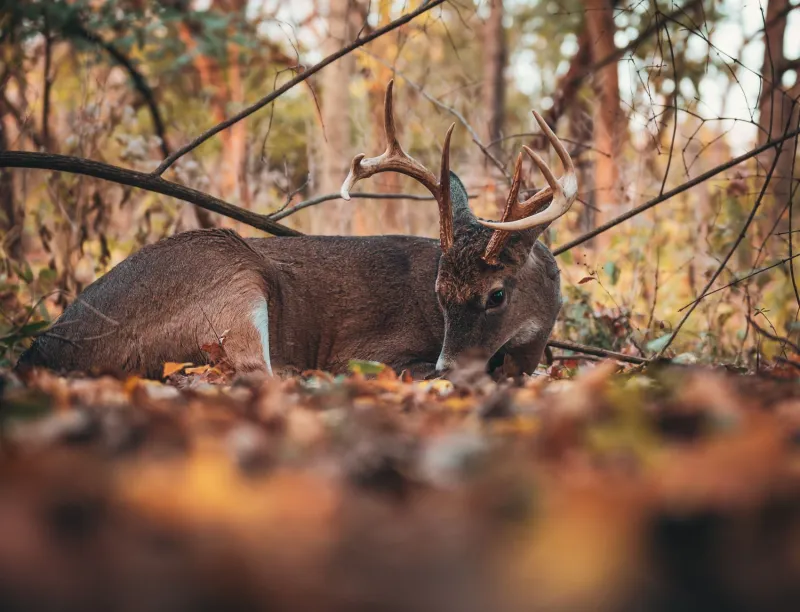
Finding where an animal sleeps is finding where it trusts the world. Bedding areas are typically on slightly elevated ground with good sight lines on at least two sides, near a thick escape route, and out of the prevailing wind. Whitetail beds are oval depressions in leaf litter or grass, roughly the size of a large dog bed, often with a slight hollow worn into the soil from repeated use.
Multiple beds clustered together — a doe group. A single large bed set apart and slightly uphill from the rest — a mature buck, bedding where he can watch his does and monitor his back trail at the same time. These aren't coincidences. These are behavioral patterns that haven't changed in ten thousand years.
Hair caught in nearby brush confirms species and can even give you a rough sense of coat condition, which tells you something about the animal's health and stress level. Matted, broken vegetation around a bed that shows signs of sudden departure — disturbance from multiple directions, scattered debris — means something spooked the animal hard. That matters if you're trying to understand predator pressure on an area.
Territorial Markers and Travel Corridors
Animals are creatures of habit, and their habits carve physical evidence into the landscape. Game trails — real ones, worn smooth by years of use — don't form randomly. They connect bedding areas to water, feeding areas to cover, and escape routes to safety. A trail that's been used for generations will be visibly compressed, free of debris, and often worn slightly below the surrounding ground level.
Scrapes — bare patches of earth where deer have pawed away leaf litter and urinated — are territorial signposts, and their condition tells you where you are in the season's cycle. Fresh scrapes with overhanging licking branches torn down and worked over mean you're in or near the rut. Old, leaf-covered scrapes that haven't been refreshed are cold history.
Musk glands, scent posts, and claw marks on trees are the animal's equivalent of a property line fence. Bobcat scrapes — small piles of debris with scat deposited on top — mark hunting territories. Beaver-cut stumps with fresh wood chips around them mean active animals within a short stretch of waterway. Every sign has a shelf life, and learning to estimate that age is the skill that separates a casual observer from someone who can actually locate game.
Building the Skill Without a Guide
This kind of awareness isn't something you pick up from a single article or a weekend course. It accumulates. The trappers who mastered it did so because they spent years in the same woodlots, watching the same animals move through the same seasonal cycles. They built a mental library of baseline — what normal looks like — so that anything unusual stood out immediately.
You build that library by slowing down and looking. Carry a small notebook and sketch what you find. Photograph sign and note the date and conditions. Walk the same ground in different seasons and different weather. Over time, the landscape starts talking to you in a language you didn't know you were learning.
No trail camera captures the whole picture. No GPS marks a bedding area's relationship to the wind. The ground truth is out there, written in scat and snapped twigs and worn soil — and it's available to anyone willing to get quiet and pay attention. That's a skill no battery failure can take away from you.