Why the Men Who Build Their Own Tools Never Panic
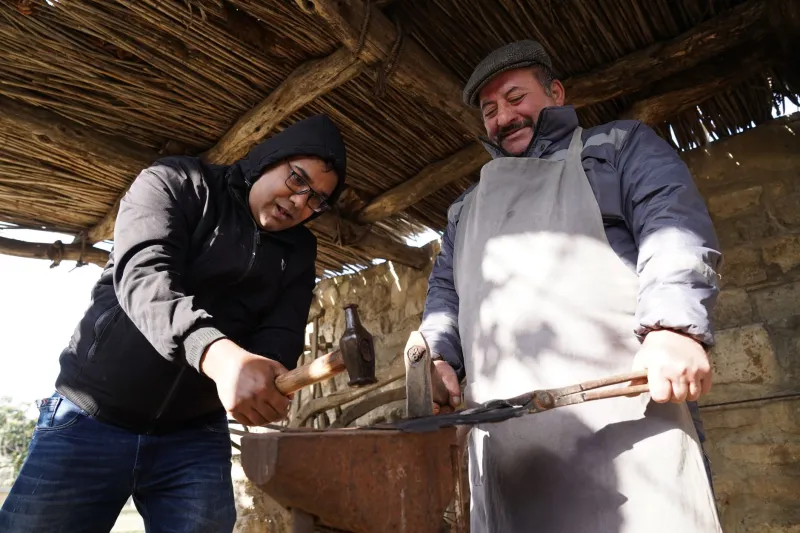
Watch a seasoned blacksmith work through a problem. The forge is running hot, a piece isn't moving the way it should, and the clock is ticking on the heat. He doesn't freeze. He doesn't scroll through YouTube for answers. His hands just... know. They adjust, adapt, and solve — almost before his conscious mind has finished forming the question.
That's not personality. That's not confidence born from arrogance. That's something neurological, something built into him through thousands of repetitions of making, failing, adjusting, and making again. And it's something that modern preppers — stocked with gear they've never built and tools they've never sharpened — are almost entirely missing.
Your Hands Learned the World Before Your Words Did
Here's the thing neuroscience keeps confirming: the human hand is not just a tool. It's a thinking organ. The motor cortex — the part of your brain that controls movement — devotes a disproportionately massive amount of real estate to the hands compared to every other body part. Your hands have more dedicated brain space than your torso, your legs, and most of your face combined.
This isn't an accident of evolution. For most of human history, survival was a manual process. You made things or you died. The hands and the brain co-evolved in a feedback loop — fine motor skill demanded neural complexity, and that complexity fed back into problem-solving, spatial reasoning, and emotional regulation. Humans got smarter, in part, because they got better with their hands.
When you pick up a hammer and start working steel, or sit down to carve a wooden handle, or lash together a friction fire kit from scratch, you're activating that ancient system. You're not just learning a skill. You're speaking a neurological language your body already understands.
Muscle Memory Is Panic-Proof
Here's where it gets practical for preppers. When stress hits — real stress, not the frustration of a dropped phone but the kind of stress that comes when infrastructure fails and people are depending on you — the prefrontal cortex, the rational thinking part of your brain, essentially goes offline. Blood flow shifts. Higher cognitive function degrades. You become reactive rather than deliberate.
This is why trained soldiers and first responders drill the same procedures thousands of times. They're not trying to memorize steps. They're encoding responses into procedural memory — the kind that lives below conscious thought and doesn't evaporate under pressure. Muscle memory, in the truest sense.
Building primitive tools does exactly the same thing. Every time you work a piece of steel, every time you split wood along the grain or shape a bowdrill spindle by feel, you're depositing into that account. The man who has hand-forged fifty blades doesn't have to think about how to grip a knife under stress. His hands already know. And when the thinking brain goes dark, the hands keep working.
Blacksmiths, woodworkers, and experienced bushcrafters will describe this in their own language — "it just felt right," or "my hands took over" — without knowing they're describing procedural memory encoding. But the experience is consistent across disciplines and centuries. Making things with your hands builds a kind of competence that purely intellectual preparation simply cannot replicate.
The Problem-Solving Shift
There's another layer to this that goes beyond panic response. Regular hand-craft practice — especially craft that involves working with unpredictable natural materials — fundamentally changes how you approach problems.
Wood has grain. Stone has fracture planes. Steel has temper points. None of these materials behave exactly the same way twice. Every piece of hickory you carve into a handle is different from the last one. Every piece of high-carbon steel responds a little differently to the forge. Working with these materials teaches you something that no amount of reading can: how to read a situation, adapt in real time, and accept that your plan is always provisional.
Researchers studying expert craftspeople have noted that master-level artisans develop what some call "material intelligence" — an intuitive understanding of how physical objects behave under stress and force. This isn't mystical. It's pattern recognition built from thousands of tactile experiences. And it transfers. The man who has learned to read grain in wood starts reading grain in problems — finding the natural lines of least resistance, working with the material rather than against it.
In a survival situation, that mindset is worth more than any piece of gear in your kit.
What Preppers Are Actually Missing
The modern prepper culture has a gear problem. Not a shortage of gear — an overabundance of it, much of it purchased, unhandled, and stored away against a future emergency. The logic seems sound: have the right tools available when you need them. But there's a critical gap between owning a tool and being able to use it under stress.
A hand-forged knife made by its owner is a different object than an identical knife bought off a shelf. Not because of metallurgy — though hand-forged tools often are genuinely superior — but because of what the making process deposits in the maker. The person who forged that blade knows exactly how it behaves. They know its balance, its edge geometry, its quirks. They built those qualities in deliberately. Under stress, that knowledge is immediately accessible in a way that no amount of practice with a store-bought tool can quite replicate.
This is why the old-timers who built their own gear — their own traps, their own handles, their own shelters — tended to be the calm ones in a crisis. Not because they were naturally unflappable, but because they had encoded competence at a level that stress couldn't reach.
Start With Your Hands
You don't need a full blacksmith shop to begin. Start with wood. Carve a spoon. Shape a mallet handle. Split shingles. The material is cheap, the tools are simple, and the feedback loop is immediate — you can feel what's working and what isn't in real time.
Move to cordage. Twist plant fibers into rope by hand and you'll understand tension and fiber mechanics in a way that reading about it never provides. Work up to tool handles, then to simple forged pieces if you can access a forge or a basic propane setup.
Every hour you spend working with your hands is an hour invested in the version of you that doesn't freeze when the lights go out. That's not a metaphor. That's neuroscience. And it's the oldest survival strategy on the planet.