Old Steel vs. New Tech: When Primitive Tools Actually Win the Survival Game
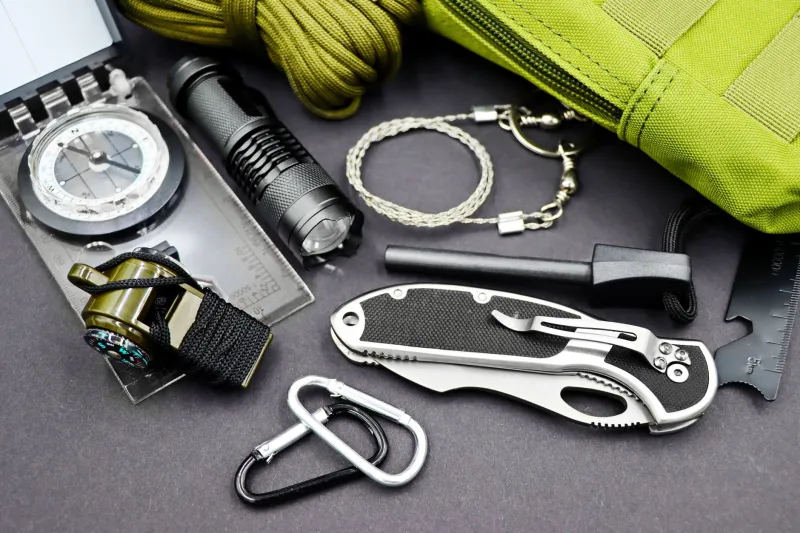
There's a debate that runs through every prepper forum, every bushcraft Facebook group, and every campfire conversation eventually: primitive tools versus modern gear. The gear heads say go modern — lighter, tougher, more reliable. The traditionalists say simplicity is its own form of reliability. Both camps have a point. And both camps are occasionally dead wrong.
Let's skip the tribalism and actually look at specific scenarios. Where does a ferro rod beat a hand-drill? Where does a stone blade outperform a $200 folding knife? The honest answer is more nuanced — and more interesting — than either side usually admits.
Shelter Building: Primitive Methods Hold Their Ground
Modern shelter options — ultralight tarps, bivy sacks, pop-up emergency shelters — are genuinely impressive. A good silnylon tarp sets up in minutes and sheds water like a champ. If you have it with you, use it.
But here's the thing about shelter: when your pack is gone, your tarp is gone with it. And in a true wilderness emergency, pack loss is more common than people want to admit — river crossings, falls, theft, vehicle loss during evacuation.
This is where primitive debris hut construction is not just a fun weekend skill — it's a legitimate backup that requires zero gear. A well-built debris hut using nothing but branches, leaves, and bark can hold body heat in temperatures well below freezing. The key is depth of insulation: you want at least two feet of dry debris packed around you on all sides.
The modern gear wins in speed and convenience. The primitive method wins in scenario where you have nothing but the land around you. A prepper who knows both is simply better off than one who only knows one.
Edge: Tie — context-dependent. Modern gear wins when you have it. Primitive wins when you don't.
Fire Starting: This One's More Complicated Than You Think
Fire is where the primitive-vs-modern debate gets genuinely interesting.
A ferro rod is objectively easier to use than a bow drill or hand drill. It works wet, it works cold, it works when your hands are shaking. For most preppers, a ferro rod is the right primary fire-starting tool — full stop. Add a backup lighter and you're covered in 99% of scenarios.
But here's where primitive knowledge earns its keep: friction fire techniques force you to understand fire at a fundamental level that lighter-flickers never develop. You learn which woods work, how tinder bundles behave, how humidity affects everything. That deep knowledge makes you better at fire in general — including with modern tools. The person who can make fire with a hand drill will never struggle with a ferro rod.
There's also a long-term SHTF consideration. Ferro rods wear out. Lighters run dry. A bow drill made from locally sourced materials? Theoretically unlimited. If you're thinking in terms of true long-term self-sufficiency — months or years, not days — friction fire isn't a party trick. It's infrastructure.
Edge: Modern gear for short/medium-term scenarios. Primitive methods for long-term self-sufficiency and skill depth.
Food Procurement: Where Primitive Tools Quietly Dominate
This is the category that surprises people the most.
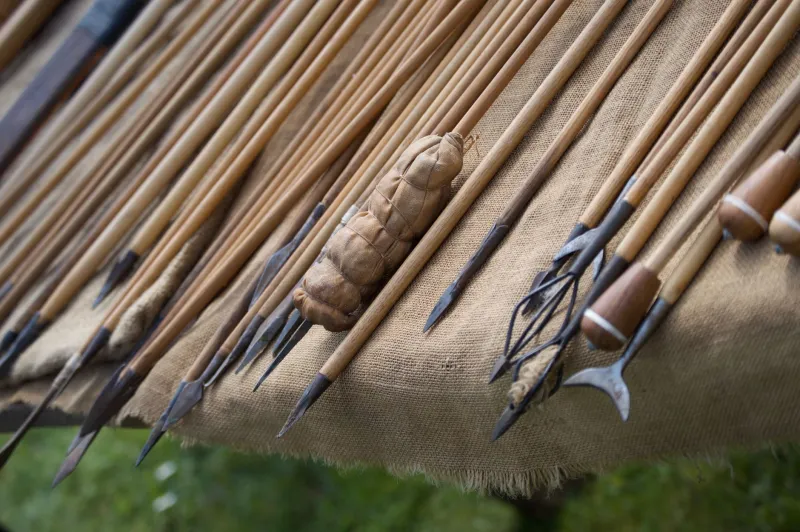
Modern hunting and fishing gear is excellent. A quality rifle, a good compound bow, a set of lures — all of it is more efficient than primitive alternatives in most circumstances. Nobody's arguing against a .308 in a grid-down scenario.
But food procurement over an extended period requires more than a single weapon. It requires a system. And primitive trapping, snaring, and fishing techniques create a passive food procurement system that works while you sleep, while you gather firewood, while you build shelter.
A well-set snare line using cordage and natural materials can produce food consistently without consuming ammunition, without requiring the user to be present, and without the mechanical failure points of modern traps. Gorge hooks carved from bone or hardwood have caught fish for tens of thousands of years. They still work.
The primitive toolkit in food procurement isn't a replacement for modern tools — it's a force multiplier. The prepper running a snare line and a fishing set while also carrying a rifle is in a categorically better position than the one who only brought the rifle.
Edge: Primitive tools — specifically for passive, sustainable food procurement over extended periods.
Cutting Tools: Modern Wins, But There's a Catch
A quality fixed-blade knife — something like a full-tang bushcraft blade in high-carbon steel — will outperform a hand-knapped flint blade in almost every practical cutting task. It holds an edge longer, handles more abuse, and is far easier to sharpen in the field.
That said, flint knapping deserves mention not because it beats modern steel but because it produces a genuinely useful tool from raw materials available across huge portions of the United States. If you can identify flint, chert, or obsidian — and you know what you're doing — you can produce a cutting edge sharper than any factory blade. That's not a small thing.
The catch with modern cutting tools is dependence on supply chains. High-quality steel knives aren't something you fabricate in the field. When they break or are lost, they're gone. Flint is literally underfoot in many parts of the country.
Edge: Modern steel for daily use. Primitive knapping as a genuine backup skill worth developing.
Navigation: Modern Gear Wins Decisively — But Know Its Limits
A quality compass and a topographic map will serve you better than any primitive navigation technique in most American wilderness scenarios. GPS devices are even more capable when batteries hold. This is one area where the case for going primitive is genuinely weak as a primary strategy.
The exception: understanding natural navigation — sun position, star patterns, prevailing wind, moss growth — adds a layer of redundancy that costs nothing to carry. It's knowledge, not gear. And when your GPS dies and your compass is at the bottom of a river, knowing that the North Star is always within one degree of true north in the Northern Hemisphere is not a trivial piece of information.
Edge: Modern gear, with natural navigation as essential backup knowledge.
The Honest Bottom Line
The prepper who swears exclusively by primitive tools is romanticizing hardship. The prepper who dismisses them as museum pieces is leaving real capability on the table.
The smartest approach — and the one this site is built around — is treating primitive skills as a foundation, not a replacement. Modern gear sits on top of that foundation and extends your capability. If the gear fails, the foundation holds.
Know both. Carry what makes sense. Respect what came before it.