Built Before Yesterday: Why Stone, Bone, and Wood Still Win the Long Game
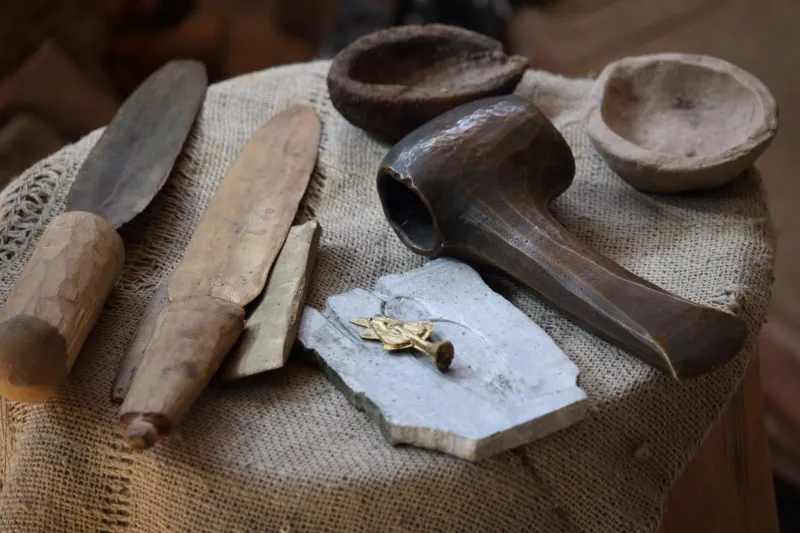
There's a flint hand axe sitting in the Smithsonian right now that's somewhere north of 700,000 years old. It still has a working edge. Your last multi-tool? Probably seized up after a wet camping trip.
That's not a knock on modern manufacturing—it's a reality check. When preppers talk about durability, the conversation almost always drifts toward tensile strength ratings, polymer blends, and corrosion-resistant coatings. What almost nobody talks about is the material that already survived every ice age, every civilization collapse, and every humidity swing the planet could throw at it.
Stone. Bone. Wood. The original toolkit. And in terms of raw staying power, nothing we've invented since comes particularly close.
The Physics Nobody's Selling You
Synthetic materials fail in predictable ways that manufacturers quietly account for in their warranty language. Polymers degrade through UV exposure, thermal cycling, and chemical contact. Coated metals pit and flake when the finish is compromised. Even stainless steel—marketed as virtually indestructible—corrodes in saltwater, weakens under sustained heat, and develops stress fractures over time.
Stone doesn't play by those rules.
Flint, chert, obsidian, and quartzite are crystalline silicates. Their molecular structure is essentially inert. They don't oxidize. They don't absorb moisture in any meaningful way. UV light doesn't touch them. The same properties that make them difficult to work with in the first place—hardness, density, chemical stability—are exactly what make them last. You're not fighting entropy when you use a stone tool. You're working with a material that entropy already gave up on.
Bone is a different story, but equally compelling. Raw bone is a composite: roughly 30% collagen protein matrix and 70% hydroxyapatite mineral. When properly dried and worked, bone tools become remarkably stable. The collagen cross-links harden over time rather than breaking down, particularly when the bone is kept away from sustained moisture. Archaeological finds from dry climates—the American Southwest, the Great Plains—routinely turn up bone awls, needles, and scrapers that are still structurally sound after thousands of years. Some anthropologists note that worked bone actually densifies slightly over long storage periods as residual moisture escapes and mineral content stabilizes.
Wood is the most nuanced of the three, and the most misunderstood. Green wood rots. Poorly dried wood warps. But properly seasoned hardwood—oak, hickory, osage orange, black locust—achieves a kind of equilibrium with its environment that modern handle materials never quite match. Native American tool handles recovered from dry cave sites have been found with their original tool heads still hafted, the wood darkened and dense but structurally intact. Traditional coopers and wheelwrights understood this intuitively: wood that's been worked, used, and oiled over decades doesn't weaken. It case-hardens. It becomes something closer to a fossil than a plank.
What 'Aging' Actually Means for These Materials
Here's where the modern prepper mindset gets it backwards. We're conditioned to think of age as an enemy—products expire, gear degrades, warranties run out. But primitive materials often improve with time and use, at least up to a point.
A well-used flint scraper develops what knappers call a 'patina'—a micro-crystalline surface layer that actually reduces friction and can slightly improve cutting performance. A bone needle smoothed by decades of use becomes more resistant to splitting, not less. A seasoned hickory axe handle absorbs shock better in year five than it did in year one, because the fibers have compressed and oriented themselves along stress lines.
Contrast that with a modern fiberglass-reinforced handle. It starts at peak performance and degrades from there. Delamination, UV brittleness, stress cracking at the ferrule—the clock is ticking from the moment you pull it off the shelf.
Real-World Examples That Should Make You Think
In 2019, a cache of Ancestral Puebloan tools was recovered from a dry alcove site in Utah. Among them were bone awls, a hafted stone scraper, and several wooden digging sticks—all roughly 800 years old, all still functional. Researchers noted the wooden implements had hardened to the point where they resembled lignum vitae in density.
Closer to home, old-timers in Appalachia still use stone-ground corn from mills fitted with granite millstones cut in the 1800s. The stones haven't worn out. The steel machinery around them has been replaced multiple times.
And if you want a more tactical example: obsidian surgical scalpels—yes, they're a real thing used in some modern surgeries—hold an edge approximately 500 times sharper than surgical steel at the molecular level. The material that a prehistoric hunter knapped into an arrowhead is literally better at certain cutting tasks than what your surgeon is using today.
What This Means for Your Kit
Nobody's saying ditch your modern gear entirely. But if you're building a serious preparedness setup, the assumption that newer equals better is a liability.
Start thinking about primitive materials as your long-term layer. The tools you want still working in ten years without maintenance, without replacement parts, without a supply chain. Stone cutting tools don't need oil. Bone handles don't need conditioning. Properly made wooden mallets don't need anything but occasional use.
Learn to knap. Learn to work bone. Learn to identify and season local hardwoods. These aren't just historical curiosities—they're the foundation of a toolkit that genuinely outlasts the grid.
The silence of stone isn't emptiness. It's patience. It's been waiting longer than any of us have been alive, and it'll be waiting long after the last polymer grip has crumbled to powder.
That's the kind of durability worth building around.